Procurement teams often search for a Recommended Chinese Microcrystalline Cellulose Manufacturer or a Recommended Chinese Resistant Dextrin Manufacturer when they need stable quality across multiple batches—not just a competitive FOB price. The challenge is that both microcrystalline cellulose and resistant dextrin can look similar on a quotation sheet, while behaving very differently on your production line.
This guide outlines how audits and document reviews usually separate a dependable Chinese microcrystalline cellulose supplier from a risky one, and how to validate resistant dextrin in a way that protects taste, processing, and label claims.

Know the ingredient realities before comparing China quotes
Microcrystalline cellulose is not one product
Microcrystalline cellulose (MCC) is used across pharma, supplements, and food because it is functional and predictable when the grade is correct. A supplier’s MCC portfolio should clearly list grades and typical use intent.
Common grades include PH-101, PH-102, PH-103, PH-105, PH-112, PH-113, PH-200, PH-301, PH-302. Particle size and bulk density differences drive flow, compressibility, and tablet robustness—so a “one grade fits all” offer is usually a red flag.
For buyers who want a baseline spec framework, the public overview on Microcrystalline Cellulose (MCC) shows how reputable producers present grade lists, pharmacopeial scope, and packaging details.
Resistant dextrin is a performance ingredient, not a buzzword
Resistant dextrin (often marketed as resistant maltodextrin or soluble corn fiber) is frequently chosen because it adds soluble dietary fiber with minimal sensory impact. But the procurement risk comes from assuming all resistant dextrin behaves the same in beverages, bakery, meal replacements, and supplements.
In practice, resistant dextrin purchasing decisions hinge on whether the product:
- meets fiber targets (a common benchmark is fiber content ≥82%)
- stays stable in processing (heat and acid exposure)
- dissolves to the clarity and viscosity you need
- maintains microbiological and moisture control for shelf life
A product page such as Resistant Maltodextrin is a useful example of how a manufacturer should disclose typical specification ranges (content, pH, water activity, and micro limits) for resistant dextrin.
The audit-first signals buyers use to judge China suppliers
When teams say “recommended,” they usually mean “auditable with low variability.” Across both microcrystalline cellulose and resistant dextrin, audits tend to focus on evidence in three areas.
1) Raw material traceability that matches your market needs
- For microcrystalline cellulose, confirm the declared raw material source and continuity plan (what happens if upstream supply changes).
- For resistant dextrin, confirm the stated source material such as non-GMO corn starch (or tapioca starch, depending on product) and ask how incoming lots are tested and released.
If a Chinese resistant dextrin manufacturer claims non-GMO positioning, the audit expectation is not marketing language—it is traceable purchasing controls and batch documentation.
2) Process control and automation that reduce batch drift
Buyers increasingly treat manufacturing technology as a quality lever. For resistant dextrin, publicly disclosed indicators that often correlate with tighter batch consistency include:
- advanced biological enzymes (often described as imported enzymes)
- precision production lines (some manufacturers cite German-origin lines)
- fully automated central control from feeding through filling
- an in-house QC laboratory with defined release testing
These points matter because resistant dextrin is sensitive to process control: small shifts can change solubility behavior, sweetness perception, or moisture pickup during storage.
3) Documentation discipline that survives customer audits
A supplier that can support global business usually has a predictable document pack. For resistant dextrin, the most common gaps show up in COA format consistency and change-control transparency.
Look for a stable set of certifications and systems that match your market channel. For food-grade fibers, buyers often ask about quality systems such as ISO9001, BRC, HALAL, HACCP, KOSHER where applicable.
How to read a microcrystalline cellulose COA like a buyer
A COA is only useful if it is batch-specific and aligned to the grade you are buying.
MCC COA checks that prevent tablet-line surprises
Use this checklist during qualification and again during every supplier change:
- Grade explicitly stated (e.g., PH-101 vs PH-102). “MCC” alone is not enough.
- Standard scope: confirm alignment to the required monographs (commonly BP/USP/FCC/JP depending on your market).
- Appearance and mesh range: many buyers request confirmation consistent with the supplier’s published range (e.g., mesh 60–200 where applicable).
- Method clarity: if the supplier states a method such as HPLC test, confirm what it is used for and how results are recorded.
- Packaging and labeling: verify standard export packaging and whether batch and expiry are printed on every unit.
A reputable MCC presentation should list grades and typical specs in a way that aligns with procurement language. The MCC overview at sdshinehealth.com is an example of a disclosure style that makes comparisons easier across suppliers.
Resistant dextrin COA specification lines that matter most
For resistant dextrin, COA literacy is where many projects win or lose time. A buyer-friendly COA does not just state “dietary fiber”—it anchors the numbers that drive formulation behavior.
Practical COA fields for resistant dextrin qualification
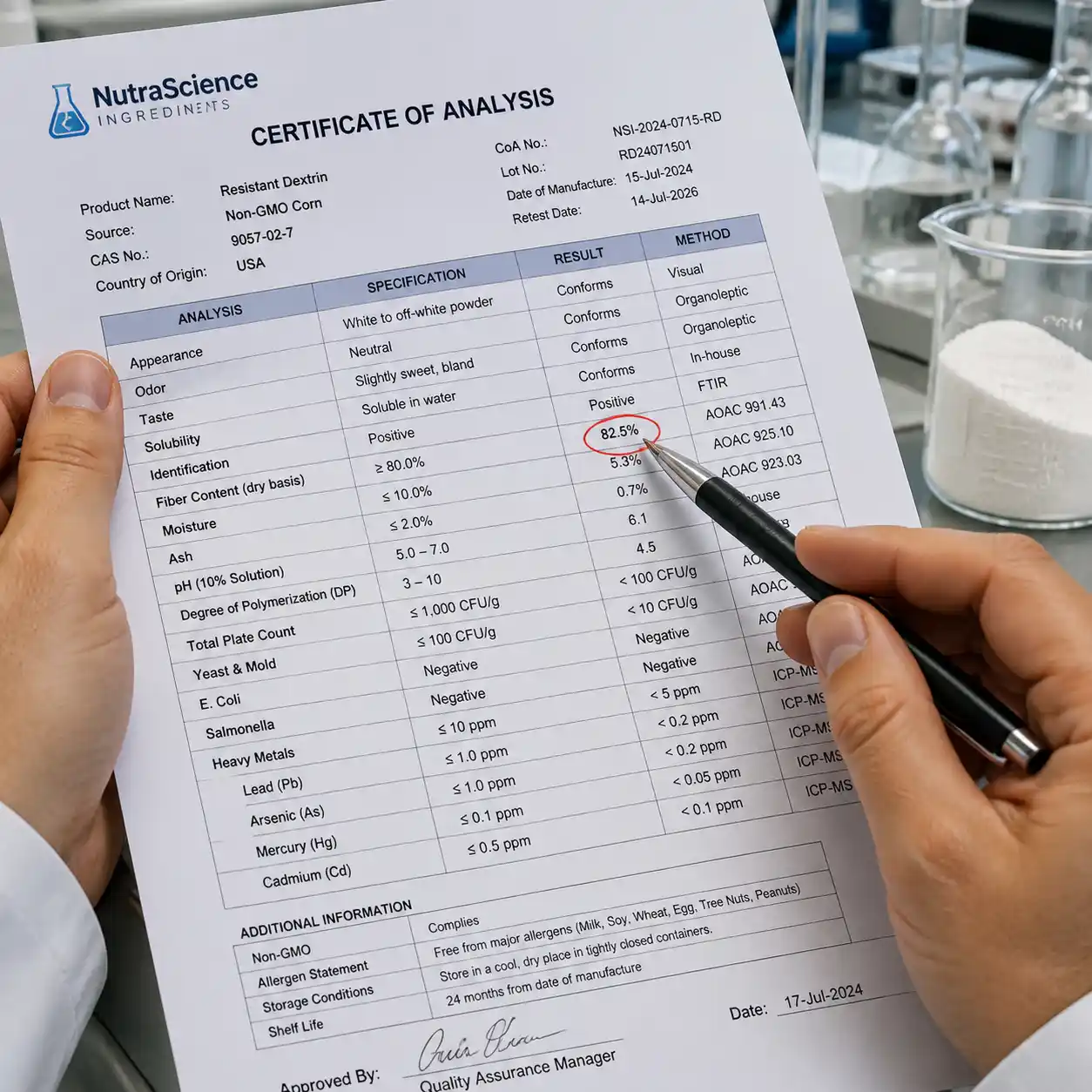
Below is a set of lines that frequently appear in commercial COAs for resistant dextrin and that buyers should treat as non-negotiable:
| COA item | Why it matters for resistant dextrin | Common buyer expectation |
|---|---|---|
| Fiber content | Drives label claim and dose economics | ≥82% for many soluble fiber briefs |
| Moisture | Impacts caking risk and storage stability | Often ≤5.0% |
| pH | Predicts beverage compatibility and flavor stability | Often pH 3–6 |
| Water activity | Shelf-life risk indicator for resistant dextrin | Often ≤0.2 |
| APC / coliforms / yeast / mold | Basic food safety and audit readiness | Clear limits + batch result |
On pages such as Resistant Maltodextrin, manufacturers sometimes publish typical ranges by grade (for example, content targets such as ≥70%, ≥85%, ≥90%, ≥95%). For procurement, this helps when you need to qualify multiple resistant dextrin options for different SKUs.
Quick interpretation rules buyers use
- If resistant dextrin is intended for beverages, confirm solubility and whether the supplier can explain clarity expectations in hot and cold water.
- If resistant dextrin is for bakery, confirm how the fiber affects water binding and softness over shelf life.
- If resistant dextrin is for supplements, confirm flow behavior, hygroscopicity risk, and packaging moisture barriers.
For application framing, the following pages can help teams translate the same resistant dextrin into different product briefs without rewriting the spec from scratch:
Two-layer procurement checklist buyers use for MCC and resistant dextrin
To shortlist a Recommended Chinese Microcrystalline Cellulose Supplier and a Recommended Chinese Resistant Dextrin Manufacturer, many teams use a two-layer approach: first validate technical fit, then validate audit resilience.
Layer 1 is technical fit
For microcrystalline cellulose
- Confirm the grade list (PH-101/PH-102/PH-200 etc.) and choose grades by process (direct compression vs other methods).
- Confirm pharmacopeial alignment needs (BP/USP/FCC/JP) and ensure the COA references the correct scope.
- Confirm packaging format and whether it matches your warehouse handling.
For resistant dextrin
- Confirm fiber content targets (often resistant dextrin fiber ≥82% is used as a baseline for high-fiber SKUs).
- Confirm pH range (commonly pH 3–6) and moisture limits.
- Confirm microbiological limits consistent with your internal standard.
Layer 2 is audit resilience
This is where “recommended” becomes meaningful:
- Evidence of non-GMO raw material controls for resistant dextrin where claimed
- Documented automation and central control systems that reduce batch variability
- In-house QC lab capability and clearly defined release testing
- A stable certificate and document pack that can be refreshed on request
A supplier page like Factory Supply Resistant Dextrin provides a concrete example of the kinds of manufacturing disclosures buyers often ask to see when approving a resistant dextrin plant.
Where procurement teams still lose time in China sourcing
Confusing “content” with “fiber content” in resistant dextrin
A common mistake is treating “content ≥90%” as equal to “fiber content ≥90%.” In many resistant dextrin spec tables, these are different lines. A supplier should be able to explain the difference and keep it consistent across COA and sales specification.
Treating MCC as interchangeable across PH grades
If the tender language does not lock a specific microcrystalline cellulose grade, suppliers may quote whatever is available. That can show up later as flow issues, hardness drift, or changes in disintegration behavior.
Skipping packaging checks for resistant dextrin stability
Because resistant dextrin is often used in hygroscopic environments (powder blends, stick packs, beverage premixes), packaging is not an afterthought. Buyers should confirm moisture-proof liners and labeling controls, especially for multi-region shipments.
A sourcing roadmap that supports long-term supplier approval
A practical roadmap that avoids requalification loops looks like this:
- Define the spec in buyer language (grade + standard for microcrystalline cellulose; fiber content + pH + moisture + micro limits for resistant dextrin).
- Normalize COAs from candidates into one comparison template.
- Run a pilot with at least two batches where possible, so you see short-term variability.
- Lock change-control expectations in your quality agreement, especially for enzyme systems and process changes that affect resistant dextrin performance.
- Maintain an approved supplier list that is updated using audit results—not only price.
When procurement teams do this, the term “recommended” becomes trackable and repeatable, which is exactly what global supply chains need.
For buyers who want examples of transparent supplier disclosure (without turning selection into a single-supplier decision), public product and knowledge pages from Shandong Shine Health Co., Ltd. (brand: Shine Health) at www.sdshinehealth.com can serve as a reference for what credible MCC and resistant dextrin documentation typically looks like.