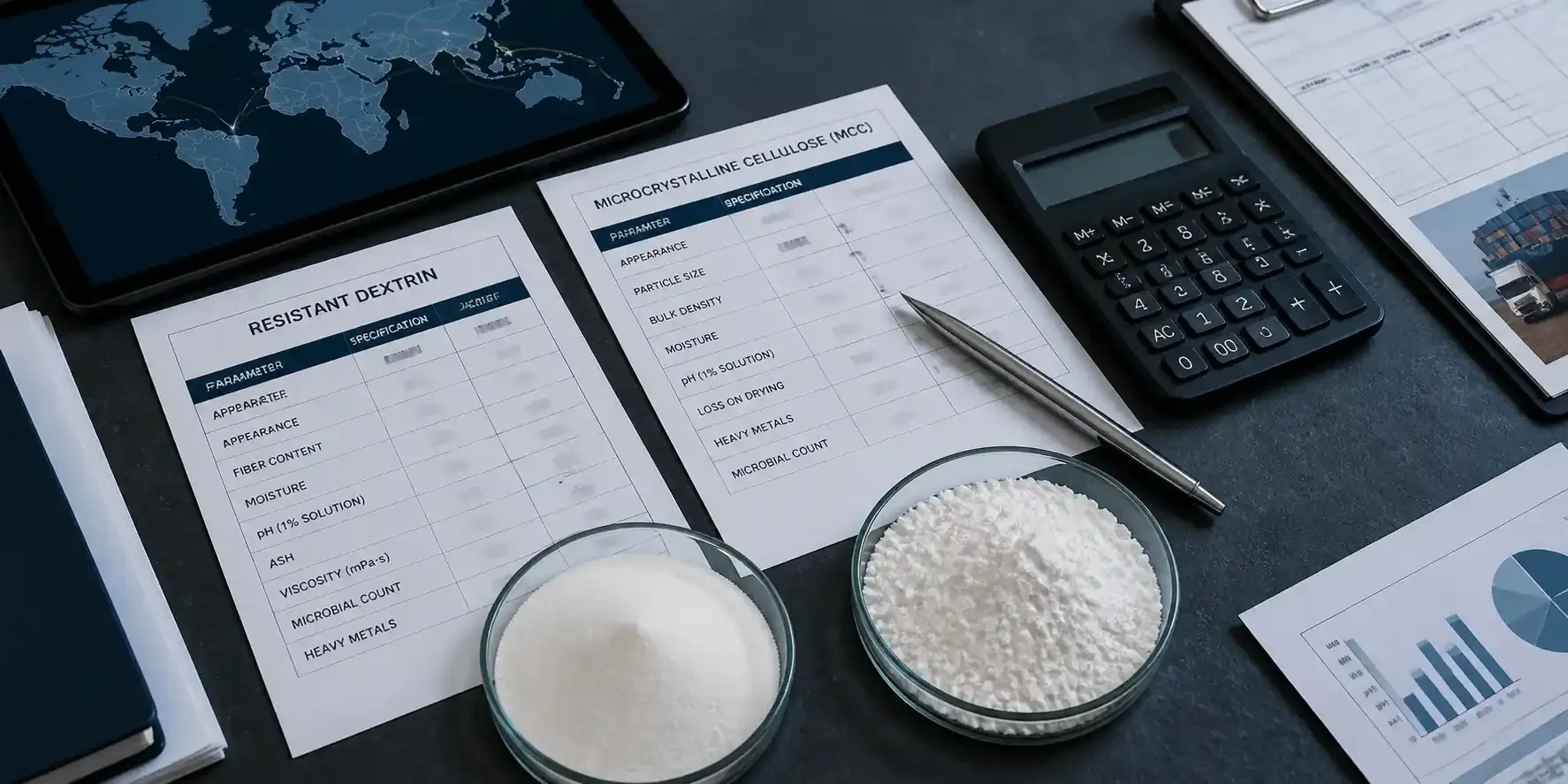
Global product teams are treating soluble fiber and excipients less like commodities and more like risk-managed building blocks. Two ingredients sit at the center of that shift: resistant dextrin for fiber-forward foods and supplements, and microcrystalline cellulose (MCC) for stable tablets and consistent textures.

As prebiotic and gut–brain research keeps expanding, brand and regulatory expectations rise with it. That makes sourcing from China a strategic decision—not simply a “find the lowest quote” task. Buyers who want a resistant dextrin supplier China can scale with, or a dependable microcrystalline cellulose supplier China, increasingly win on total cost of ownership (TCO): cost-in-use, batch consistency, documentation readiness, and logistics reliability.
Market signals that are changing sourcing behavior
Three market realities are converging:
- Prebiotic and healthy-aging narratives are strengthening. Recent coverage of clinical work exploring prebiotic fibers and cognitive performance has pushed procurement teams to ask harder questions about how prebiotic claims are supported—and whether suppliers can provide clear technical files and consistent batches. (See the external data sources at the end.)
- EU-style compliance expectations are spreading. Even when a product is not directly regulated under REACH, the “REACH mindset” is influencing supplier evaluation: traceability, controlled processes, and documentation discipline. That mindset affects how buyers shortlist a Chinese microcrystalline cellulose manufacturer as well as a resistant dextrin supplier China.
- Taste and texture define whether fiber products repeat. Fiber snacks, clear beverages, and powder blends succeed or fail on mouthfeel, processing stability, and sensory neutrality—not on label claims alone.
For buyers, the implication is simple: a supplier that cannot prove consistency and compliance will raise the real cost, no matter how attractive the unit price looks.
MCC and resistant dextrin fundamentals that drive cost in use
Procurement teams often compare MCC and resistant dextrin as if they are interchangeable “white powders.” They are not, and misreading fundamentals is one of the fastest ways to break a TCO model.
Understanding where each ingredient creates value helps buyers avoid false comparisons. Resistant dextrin is often assessed through formulation ease, sensory neutrality, and solubility, while MCC is more tightly linked to tablet mechanics, grade consistency, and process robustness. Treating both as commodity fillers can lead to poor RFQ design, incomplete trial protocols, and unrealistic landed-cost assumptions. A better approach is to tie specifications to functional outcomes in the final product, not only to a generic certificate. This distinction is especially important when teams are aligning procurement, QA, and R&D around one approval path instead of separate decision tracks.

Resistant dextrin for fiber products
Resistant dextrin is a soluble dietary fiber produced from starch sources such as corn. It is valued because it is typically easy to formulate, can be stable under heat and acidity, and can support fiber claims without the grainy texture associated with some insoluble fibers.
From a cost perspective, resistant dextrin creates hidden savings when it:
- Maintains a neutral taste (less masking flavor, fewer sweetness corrections)
- Dissolves well (less downtime from clumping, fewer filtration issues)
- Performs consistently across batches (fewer reworks and fewer sensory retests)
When shortlisting a resistant dextrin soluble dietary fiber supplier, buyers should align internal specs to the intended application. For example:
- Clear drinks tend to prioritize solubility and clean taste.
- Baked goods prioritize process stability and texture.
A useful starting point for spec language and application context can be found on pages such as resistant dextrins for baked goods, which illustrates why fibers that preserve texture are becoming procurement priorities.
Microcrystalline cellulose for tablets and texture control
MCC is a widely used excipient and functional additive, often chosen for its binding and disintegration behavior in tablets, and for stabilization and texture support in food applications.
A microcrystalline cellulose supplier China should be evaluated by how well it helps prevent production variability. On the MCC side, real cost often shows up in:
- Compression performance and flow (fewer tablet defects)
- Particle size control across grades (less trial-and-error between PH types)
- Pharmacopoeial alignment and test methods (less regulatory friction)
Buyers comparing options from a Recommended Chinese Microcrystalline Cellulose Manufacturer profile usually focus on whether the supplier can provide a stable grade portfolio and consistent compliance alignment. A practical reference point for typical MCC grades and standards is the product overview at microcrystalline cellulose wholesale.
An eight point checklist to evaluate Chinese suppliers with fewer blind spots
The goal is not to “over-audit.” It is to standardize how procurement, QA, and R&D define a supplier that will not create downstream cost.
1) Raw material proof and traceability
For resistant dextrin, many buyers now request non-GMO statements when positioning requires it, and they want clarity on starch origin and traceability. A supplier that can clearly describe non-GMO sourcing and traceability reduces claim risk.
One relevant example of how suppliers communicate this expectation is the page describing natural raw material soluble corn fiber, which outlines non-GMO sourcing and traceability framing.
2) Process control and automation
Automation matters because it typically improves batch-to-batch control and reduces human variability. For a resistant dextrin supplier China, automated feeding, controlled enzymatic steps, and controlled filling are often a proxy for consistency.
For MCC, process control is equally important because variations in particle distribution and moisture can affect flow and compression.
3) In-house QC capabilities
A fully equipped lab does more than generate a COA—it enables faster root-cause analysis when a batch behaves differently in your line. Buyers should ask what is tested in-house versus outsourced, and what is tested at what frequency.
4) COA, TDS, and “audit-ready” document discipline
At minimum, ask for:
- COA with clear test items and limits
- TDS with intended use and stability notes
- Microbiological limits (where relevant)
- Allergen and non-GMO statements (where relevant)
Inconsistent paperwork increases hidden procurement labor cost and can delay approvals.
5) Spec alignment to application, not just to a generic sheet
A resistant dextrin soluble dietary fiber supplier should support application-specific trials (RTD beverage, baked goods, powder blends). A microcrystalline cellulose supplier China should support the grade selection that matches direct compression, wet granulation, or other tablet processes.
6) Packaging integrity and moisture protection
Moisture pickup can destroy flow properties (MCC) and create caking in soluble fibers. Packaging quality and labeling discipline are part of TCO, not a “logistics detail.”
7) Export experience and customs readiness
Export-ready suppliers help reduce delays with accurate documentation, stable labeling, and responsive communication when customs questions arise.
8) Corrective action speed
The best suppliers respond like operational partners: clear timelines, traceable batch data, and fast technical communication. Slow corrective action is an early sign of future downtime.
A practical TCO model for MCC and resistant dextrin sourced from China
A buyer-friendly TCO model does not need to be complicated. It needs to be repeatable across RFQs.
Step 1 set the cost boundary
Include:
- Unit price (FOB or CIF)
- Freight and insurance
- Import duties and port fees
- Warehousing and internal handling
- Quality and regulatory labor (document review, testing, release time)
Step 2 quantify cost in use
For resistant dextrin, track:
- Effective fiber delivery per finished serving (if fiber targets drive usage rate)
- Rework rate due to sensory or dissolution issues
- Line impact (mixing time, filtration, downtime)
For MCC, track:
- Tablet defect rate (capping, lamination, weight variation)
- Press speed changes or tooling wear impacts
- Batch-to-batch revalidation effort
Step 3 price the risk events
Common risk events include:
- A batch fails micro or moisture spec and must be replaced
- A missing document delays customs clearance
- A grade mismatch forces reformulation or new stability work
Even one event can erase apparent savings from a low unit price.
Step 4 compare suppliers on a single page
Procurement teams often find value in scoring each supplier on:
- Consistency risk
- Document readiness
- Logistics reliability
- Technical support quality
Then align the score to a “cost of risk” multiplier.
How to apply the framework when building a shortlist
A practical workflow that avoids overwork looks like this:
- Desk screening: confirm product fit, basic specs, export markets served, and document samples.
- Document review: verify COA format, TDS clarity, micro limits, non-GMO statements where needed.
- Sample trials: run small trials in the intended formats (tablet, beverage, baked good).
- Scale confirmation: request a second lot to validate batch-to-batch consistency.
- Audit planning: perform a remote audit or on-site visit based on risk and category.
When buyers want to benchmark how a supplier describes fiber products and sourcing fundamentals, pages such as soluble fiber powder and abundant dietary fiber tapioca resistant dextrin powder can be useful reference points for what “procurement-ready” product communication looks like.
Checklist questions buyers should ask before approving any supplier
Use these questions for any resistant dextrin supplier China or microcrystalline cellulose supplier China during RFQ and qualification:
- Which starch or fiber raw materials are used, and what traceability documents can be shared?
- What are the key routine QC tests, and which are performed in-house versus outsourced?
- Can the supplier provide recent COAs with clear limits for moisture, pH (where applicable), and microbiological counts?
- How does the supplier control batch consistency (automation level, process controls, and release criteria)?
- What packaging is used to control moisture pickup during shipping and storage?
- What standards or monographs does the MCC align to, and how are test methods documented?
- What is the typical lead time, and what happens during peak seasons or logistics disruptions?
- If a deviation occurs, what is the documented corrective action process and response timeline?
A supplier that answers these cleanly is closer to “recommended” in the way procurement teams use the term—less about marketing, more about operational certainty.
Data sources used in this article
- Shine Health guidance on resistant dextrin raw material and sourcing context: https://www.sdshinehealth.com/resistant-dextrin/natural-raw-material.html
- Shine Health MCC grades and standards overview: https://www.sdshinehealth.com/microcrystalline/microcrystalline-2.html
- Shine Health application context for baked goods: https://www.sdshinehealth.com/resistant-dextrin/resistant-dextrins.html
- Prebiotic and cognition coverage (industry signal): https://www.sciencealert.com/cheap-daily-supplements-may-boost-brain-functions-in-older-people
- EU REACH compliance signal for cellulose-related materials (regulatory signal): https://www.digitaljournal.com/pr/news/newsfile/kima-chemical-announces-completion-eu-1516748717.html
For more information on compliant MCC and resistant dextrin sourcing options from China, visit www.sdshinehealth.com.