Global demand for soluble dietary fiber and tablet excipients keeps rising, but the procurement reality has not changed: the lowest FOB number rarely equals the lowest total cost. This is especially true when sourcing resistant dextrin (also called resistant maltodextrin or soluble corn fiber) alongside microcrystalline cellulose (MCC) from China.
For most buyers, the budget fails in the same place—spec discipline. A quote is only as stable as the specification behind it. If resistant dextrin targets are vague (fiber content range, pH, moisture, micro limits, solubility), or if MCC grade requirements are unclear (particle size, density, compressibility), landed cost becomes unpredictable and reformulation risk quietly turns into a line item.
The real reason China quotes “move” after the PO
A China quote often looks solid until one of these cost traps appears:
- Grade ambiguity: “Food grade resistant dextrin” or “pharma MCC” without a tight grade definition invites substitutions that change performance.
- Documentation gaps: Missing or inconsistent COA/TDS/SDS forces extra testing, delays customs clearance, or triggers internal QA holds.
- Application mismatch: A resistant dextrin that works in bars may behave differently in a clear beverage; an MCC grade that compresses well may still fail flow targets on a specific line.
- Logistics assumptions: Packaging, pallet patterns, and humidity control matter more for powders than many budgets assume.

A reliable resistant dextrin supplier is not defined by marketing claims; it is defined by how consistently the supplier can hit the same spec lines, batch after batch, and how complete the export documentation stays over time.
What you are actually buying when you buy resistant dextrin
From a buyer’s perspective, resistant dextrin is not simply “fiber powder.” It is a performance bundle:
- Nutritional function: A soluble dietary fiber designed to resist digestion in the small intestine and ferment in the colon, supporting prebiotic positioning.
- Process stability: Often chosen because it can remain stable under heat and acid conditions that would degrade other ingredients.
- Sensory impact: Typically valued for a neutral taste profile and low impact on texture when used correctly.
In practical procurement terms, the resistant maltodextrin technical datasheet is the commercial contract—because it predicts whether your plant will run smoothly.
Spec lines that most strongly influence cost and risk
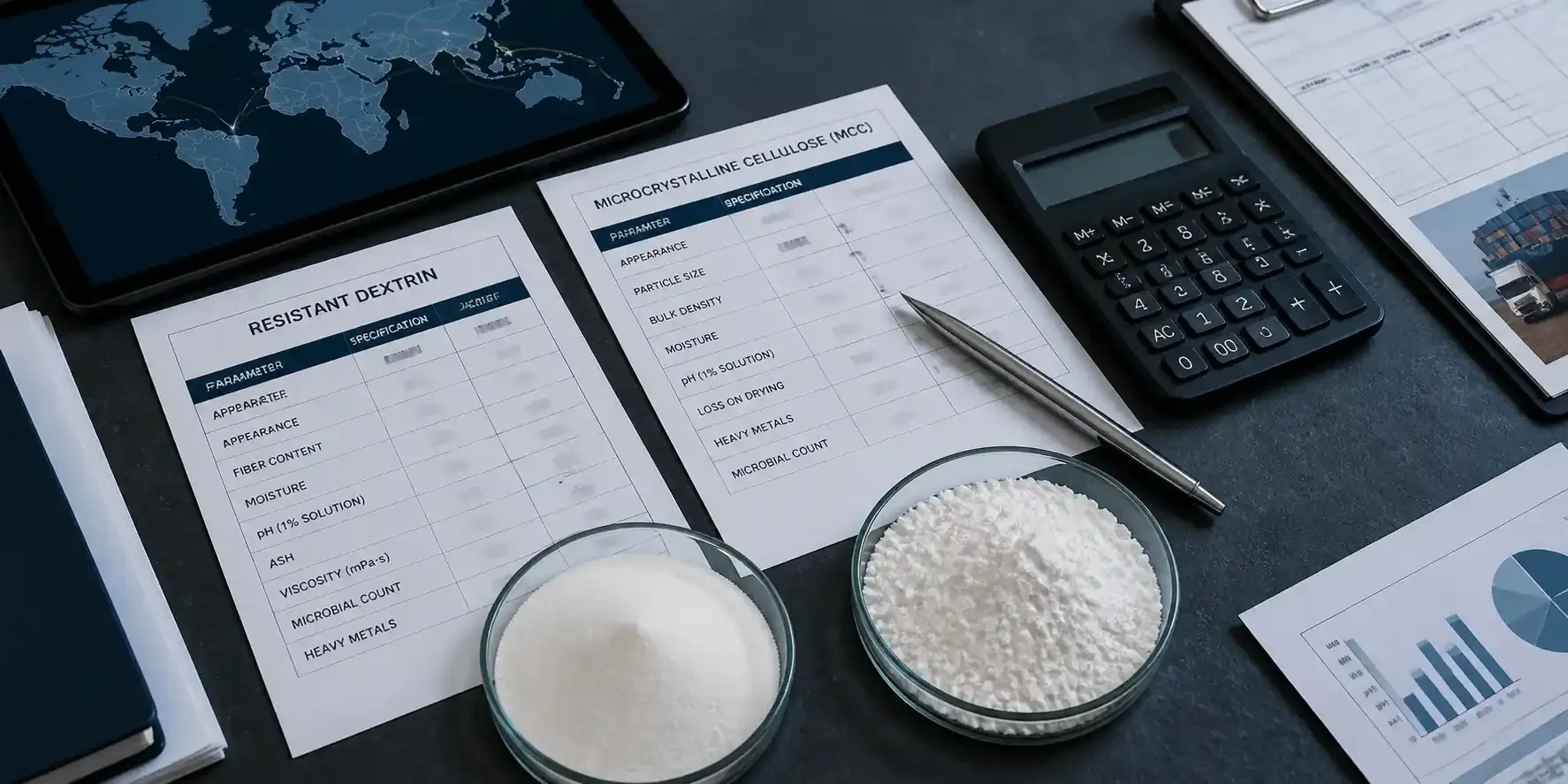
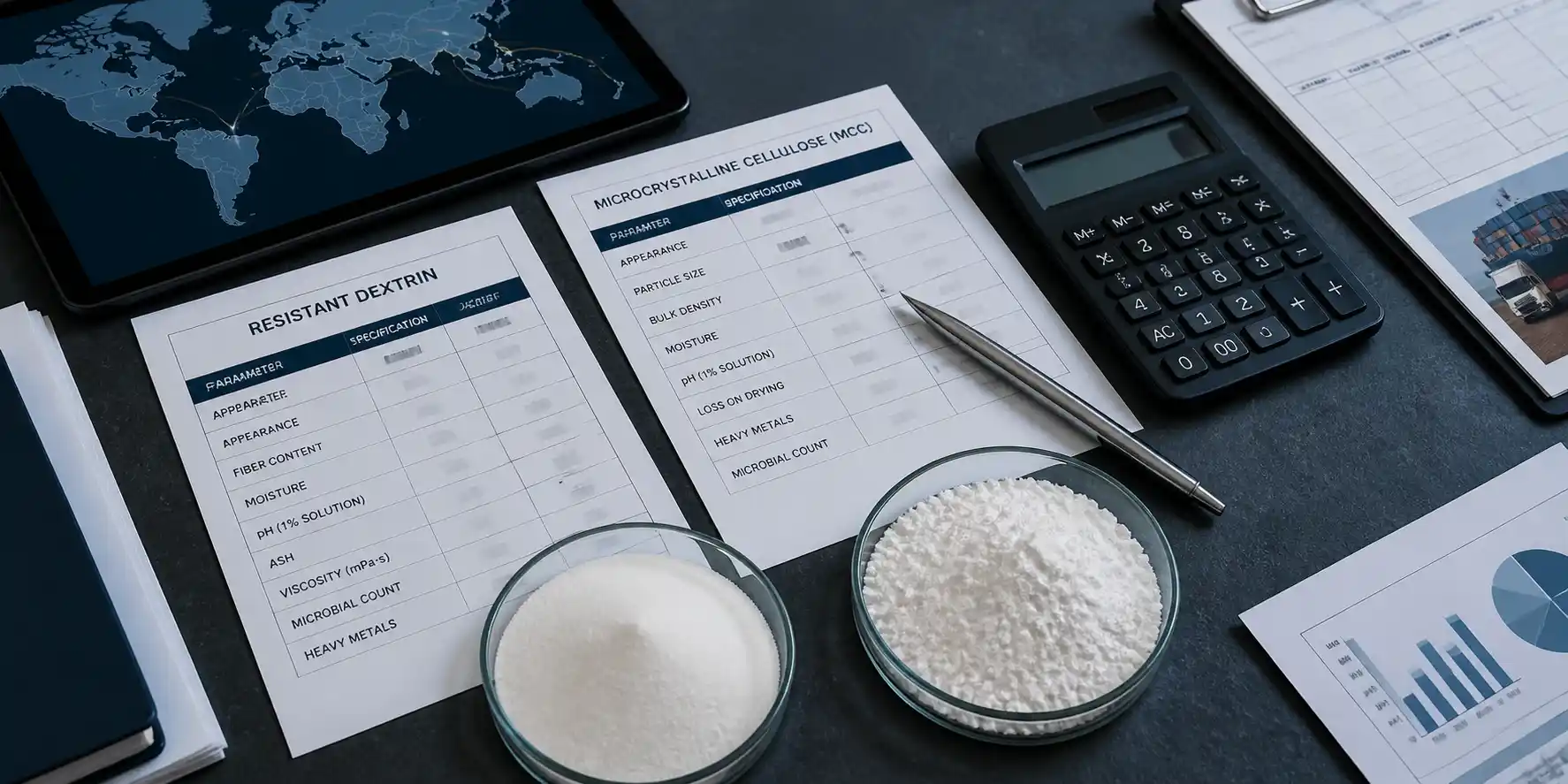
The following parameters—commonly seen in resistant dextrin documentation—are also the ones that create price tiers and hidden costs.
| Parameter | Typical expectation in supplier documents | Why it changes your total cost |
|---|---|---|
| Appearance | White to light yellow powder | Signals consistency and filtration/processing control |
| Fiber content | Often ≥82% (and may be offered in higher tiers) | Higher fiber targets can reduce dosage but raise unit price |
| Moisture | Often ≤5.0% | Impacts flowability, caking risk, and shelf stability |
| Ash | Often ≤0.1% | Indicates purity; affects taste and downstream stability |
| pH | Often 3–6 | Critical for beverages and acid systems |
| Water activity | Often ≤0.2 | Impacts storage safety and transport stability |
| Micro limits | APC, coliforms, mould, yeast limits are commonly specified | Drives QA release time, third-party testing cost, and recall risk |
A common buyer error is treating these as “nice to have” lines. In practice, every deviation triggers one of three expenses: rework, additional testing, or write-offs.
Where resistant dextrin delivers the most value
Two application areas are particularly sensitive to spec stability:
- Soluble dietary fiber for beverages: Clarity, pH tolerance, and microbiological control determine whether beverage trials pass without flavor drift.
- Low-carb baked goods: Consistent moisture behavior and process stability affect texture, shelf life, and batching repeatability.
For buyers comparing bulk resistant dextrin China offers, it helps to treat fiber content and micro limits as “must-lock” items rather than negotiable ranges.
MCC is a grade-driven purchase, not a commodity
If resistant dextrin is frequently purchased for nutritional functionality, MCC is typically purchased for manufacturing performance—as a binder/filler and processing aid in tablets and similar formats.
What causes budget surprises in MCC is the same theme: unspecified grade.
A “microcrystalline cellulose supplier China” quote can look competitive while hiding major differences in:
- Particle size distribution (affects flow and blending)
- Bulk density (affects packaging and dosing)
- Moisture content (affects stability and compression)
- Compressibility (affects tablet hardness and friability)
To keep MCC sourcing budget-stable, procurement teams should request a clear grade definition and quality discussion early. A useful starting point for internal alignment is the MCC grade guidance shared here: MCC Grades Formulation and QC Guide.
What makes a China plant financially reliable for long-term supply
Buyers often ask how to judge whether a China resistant dextrin manufacturer will remain stable for multi-year supply. While financial statements may not be available, procurement can still validate operational reliability through observable signals:
- Raw material clarity: Resistant dextrin commonly uses non-GMO corn starch as a primary input in export-oriented supply.
- Process capability: Advanced enzymatic processing, automated control, and consistent filtration/drying reduce batch variation.
- QC readiness: A fully equipped QC laboratory and consistent COA formatting reduce your internal QA workload.
- Audit friendliness: Certifications and clean workshop controls reduce the cost of ongoing supplier maintenance.
A Shandong-based producer profile that reflects these characteristics can be reviewed as an example of an export-oriented resistant dextrin supply model on nutritional supplements additives and fiber production information. (This link is useful as a benchmark when building a supplier scorecard—not as a substitute for your own qualification.)
Cost levers importers overlook when buying fibers in bulk
For teams that want predictable landed cost, the best approach is to list the major levers that typically sit outside the unit price:
1) Spec tightening vs reformulation cost
A cheaper resistant dextrin that forces additional sweetener balancing, stabilizers, or processing tweaks can eliminate the apparent savings. Spec tightening—especially on fiber %, moisture, pH, and micro limits—often lowers total cost.
2) Documentation completeness
Your document pack affects:
- customs clearance time
- third-party testing scope
- QA release speed
- customer complaint handling
In high-frequency purchasing, “document quality” becomes a measurable cost driver.
3) Packaging and humidity control
Powders are unforgiving. Packaging decisions influence damage rates, caking risk, and warehouse handling cost. Standard bulk packaging is commonly 25 kg bags with an inner liner, but the buyer should confirm liner type, palletization, and container loading practice.
4) Logistics and buffer stock
The most underestimated cost in Latin America and similar regions is not freight—it is service-level stock. If you cannot buffer inventory, you pay for expedites or missed launch windows.
A cost-smart sourcing workflow that turns quotes into budgets
Procurement teams that consistently hit budget typically follow a staged workflow. The goal is to prevent “quote drift” by forcing clarity before scale.
Step 1 Build a specification-led RFQ
Include, at minimum:
- target fiber content (and acceptable range)
- moisture maximum and pH range
- microbiological limits required for your category
- intended application (e.g., soluble dietary fiber for beverages vs bakery)
- for MCC: grade intent (direct compression vs wet granulation) and key physical parameters
Step 2 Require a document checklist before pricing is finalized
A practical checklist:
- COA template with test methods and limits
- TDS (your internal teams will treat this as the control document)
- SDS
- allergen and GMO statements where applicable
- packaging and storage conditions
Cost checklist: If any item is “to be provided after order,” treat it as a future delay cost—and price the risk.
Step 3 Run sample and pilot trials against real process conditions
For resistant dextrin, trial in at least one acid system and one thermal process if those are relevant to your product line. For MCC, evaluate flow, blend uniformity, and compression response on representative equipment.
Step 4 Model landed cost explicitly
A stable landed-cost worksheet should include:
- unit price (FOB/CIF)
- inland freight and export fees
- ocean/air freight assumptions and insurance
- import duties and local handling
- third-party lab testing and hold time
- inventory carrying cost (especially if buffer stock is required)
Step 5 Contract for stability, not just price
Budget predictability comes from commercial terms:
- lead time commitments
- quality complaint handling and replacement logic
- change-control expectations for specs and process
- packaging standards locked into the contract
When buyers need a concrete example page for internal linking or RFQ notes, the phrase factory supply resistant dextrin can be mapped to a supplier overview here: factory supply resistant dextrin.
Regional lens for Latin America using Peru as a demand signal
Latin American functional ingredient demand is often more elastic than planners expect: once fiber-enriched products reach retail acceptance, ordering patterns can spike quickly.
One public example of this demand signal is a Peru case related to wholesale functional fibers, including polydextrose, documented here: Peruvian customers sourcing polydextrose wholesale.
For resistant dextrin and MCC buyers shipping into Latin America, three budget practices usually outperform “buy only when low” strategies:
- Incoterm discipline: Align Incoterms with internal capability (FOB control vs CIF simplicity).
- MOQ planning: Don’t optimize for unit price if it causes stockouts; optimize for service level.
- Buffer strategy: Treat buffer inventory as insurance against demand spikes and port variability.
Closing guidance for recommended China suppliers
“Recommended” is not a label a supplier gives itself. For procurement teams, a Recommended Chinese Microcrystalline Cellulose Manufacturer or Recommended Chinese Resistant Dextrin Manufacturer is simply the vendor that keeps your specs stable, documents complete, and batches consistent—at a total cost your finance team can forecast.
A practical next step is to use public technical pages as benchmarks, then build a supplier scorecard that reflects your own application risks. For buyers who want a starting library for resistant dextrin specs and production cues, the manufacturer information hosted at www.sdshinehealth.com can serve as one reference point while building a wider shortlist across China. If deeper insight into compliant resistant dextrin and MCC supply models is required, procurement teams may also consult industry partners for tailored sourcing and quality solutions built around these benchmarks.