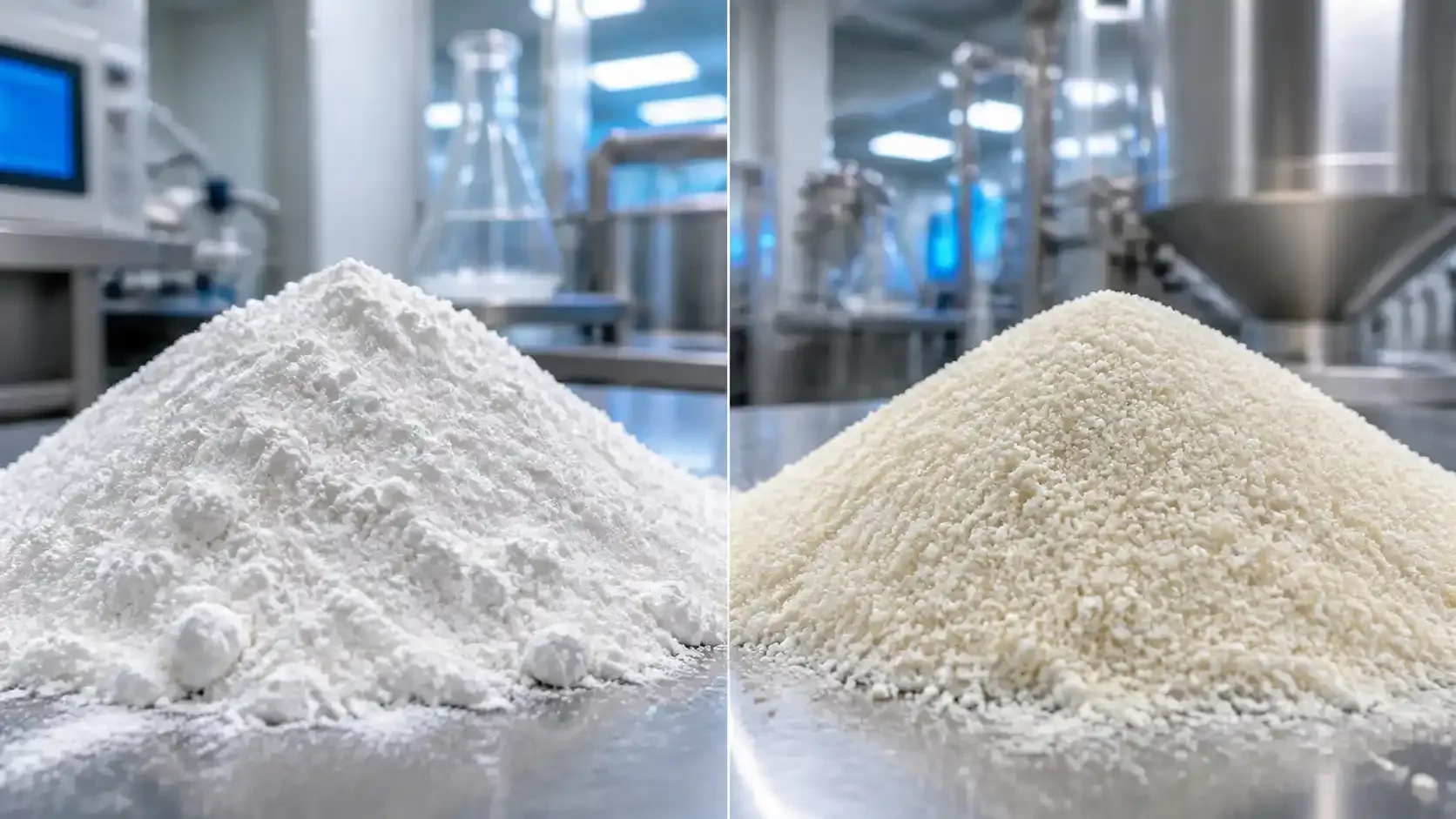
In the rapidly expanding markets for functional foods and nutraceuticals, resistant dextrin and microcrystalline cellulose (MCC) are crucial components. Procurement teams face increasing pressure to secure high-quality ingredients that meet stringent label claims and production demands. This guide explores the evolving landscape of fiber and excipient procurement, offering insights into how discerning buyers evaluate Chinese suppliers based on verifiable process control, quality systems, and traceability, rather than just price.

Fiber and Excipient Growth Reshaping Procurement Behavior
Dietary fiber and tablet excipients are no longer mere commodity inputs. Buyers in functional foods, nutraceuticals, and adjacent wellness categories now assess these materials as performance-critical ingredients tied directly to formulation stability, label positioning, and downstream manufacturing efficiency. Resistant dextrin is often evaluated for solubility, digestive tolerance, taste neutrality, and labeling suitability, while microcrystalline cellulose is reviewed for particle behavior, compressibility, flowability, and consistency in solid dosage systems.
As end markets mature, procurement teams increasingly move away from price-led decisions and adopt broader qualification standards. This shift is especially visible when sourcing from China, where supplier options are extensive but quality variance can be significant. Serious buyers usually compare not only quotations, but also process discipline, batch reproducibility, audit readiness, and the supplier’s ability to provide credible technical evidence under commercial pressure.
What Sophisticated Buyers Actually Look For
Experienced sourcing teams usually evaluate Chinese suppliers through a layered framework. Commercial attractiveness matters, but it rarely stands alone. Instead, buyers look for signals that indicate whether a supplier can support long-term business with fewer operational surprises.
- Clear product specifications with stable physical and chemical parameters
- Documented quality systems and routine batch testing procedures
- Traceability from raw material intake to finished lot release
- Consistency in documentation across COA, specification sheet, and production records
- Responsiveness when handling deviations, claims, or change notifications
These criteria are especially important when an ingredient supports a fiber claim, tablet integrity, or formulation functionality. A buyer may tolerate minor commercial differences, but usually not uncertainty around analytical reliability or manufacturing control.
Why Process Control Carries More Weight Than Marketing Claims
Buyers often encounter polished brochures and technically broad claims, yet the decisive factor is whether a supplier can demonstrate control over the process conditions that influence finished product performance. For resistant dextrin, this can include hydrolysis and purification consistency, moisture management, microbiological control, and lot-to-lot solubility behavior. For MCC, attention frequently turns to source material uniformity, drying conditions, milling control, bulk density stability, and particle distribution.
When a supplier can explain how critical control points are monitored and how out-of-specification risks are managed, procurement teams gain more confidence. This is particularly valuable during scale-up, regulatory review, or customer complaint investigations, where evidence matters far more than generic quality language.
Quality Systems That Support Buyer Confidence
Quality assurance is often the bridge between supplier claims and commercial trust. Buyers usually prefer suppliers that maintain structured systems instead of relying on final inspection alone. In practical terms, this means incoming raw material checks, in-process monitoring, finished product release standards, retention sample programs, and document control discipline.
For many buyers, the most persuasive evidence comes from consistency across documents. If specification limits, certificates of analysis, testing frequency, and declared methods align logically, the supplier appears better managed. If technical documents conflict or seem copied from unrelated templates, confidence drops quickly.
| Evaluation Area | What Buyers Verify | Why It Matters |
|---|---|---|
| Specifications | Clarity, test limits, method relevance | Reduces ambiguity during purchasing and release |
| QC Records | Batch testing completeness and trend consistency | Indicates reproducible manufacturing control |
| Traceability | Lot linkage across raw materials and finished goods | Supports recalls, investigations, and compliance |
| Change Management | Notification procedures and impact assessment | Protects formulation and regulatory stability |
Traceability as a Competitive Signal
Traceability has become a practical buying criterion rather than a theoretical compliance topic. Ingredient buyers want to know whether a finished lot can be tracked backward to raw material intake and forward to shipment history. In a cross-border supply environment, strong traceability reduces risk during quality events, customs review, customer audits, and internal investigations.
For resistant dextrin and MCC suppliers, traceability is also a sign of operational maturity. A supplier that can quickly retrieve lot records, production dates, testing data, and packaging details usually inspires more trust than one that responds slowly or inconsistently. Buyers often interpret response speed as a proxy for underlying system discipline.
Documentation Buyers Commonly Request
Before qualification, buyers frequently ask for a defined technical document package. The goal is not only to collect files, but to assess whether the supplier’s information is coherent, current, and specific to the offered material.
- Product specification sheet
- Certificate of analysis format or recent example
- Manufacturing flow summary
- Allergen, GMO, and contaminant statements where relevant
- Packaging, storage, and shelf-life details
- Quality certification and audit questionnaire responses
Well-prepared suppliers usually provide these materials promptly and in a format suitable for technical review. Delays, vague answers, or inconsistent versions often trigger deeper scrutiny, especially for buyers supporting branded finished products.
Reading Market Signals Beyond the Offer Sheet
Buyers also watch indirect signals. Stable communication, realistic lead times, controlled document revisions, and clear answers to technical questions all contribute to supplier credibility. If a supplier promises every specification, every custom request, and every timeline without qualification, experienced buyers may become cautious rather than impressed.
Another market signal is how a supplier explains variability. Reliable partners do not deny all risk; they explain what can vary, what is tightly controlled, and what safeguards exist. That kind of transparency is especially valued in China sourcing, where procurement teams must distinguish between trading behavior and genuine manufacturing capability.
How Buyers Compare Resistant Dextrin and MCC Suppliers in Practice
In real procurement workflows, buyers often create side-by-side comparison grids that combine technical, operational, and commercial criteria. Resistant dextrin may be scored on fiber content alignment, dispersibility, sensory neutrality, and documentation support for intended use. MCC may be compared based on compaction performance, particle characteristics, moisture behavior, and packaging suitability for manufacturing environments.
Cost remains relevant, but the lowest quote often loses value if it introduces retesting burdens, formulation instability, late shipments, or customer complaints. For this reason, many teams look at total procurement risk instead of landed cost alone.
Using Supplier Communication as a Due Diligence Tool
Procurement and technical teams can learn a great deal from the way a supplier communicates. Strong suppliers tend to answer with specifics, define test methods clearly, and distinguish between standard capability and custom options. They also tend to keep their claims within the boundaries of documented evidence.
If you are reviewing suppliers connected to www.sdshinehealth.com, it is useful to compare published product positioning with the technical materials, image assets, and formal quality documentation provided during inquiry. Alignment across these channels can help indicate whether commercial messaging is backed by controlled operational practice.
Conclusion
As the markets for functional fibers and pharmaceutical or nutraceutical excipients continue to expand, procurement standards are becoming more evidence-based. Buyers evaluating Chinese resistant dextrin and microcrystalline cellulose suppliers are increasingly guided by process control visibility, quality system maturity, traceability strength, and documentation coherence. In this environment, the most competitive suppliers are not simply the cheapest. They are the ones that can consistently prove what they make, how they control it, and how reliably they can support customer requirements over time.