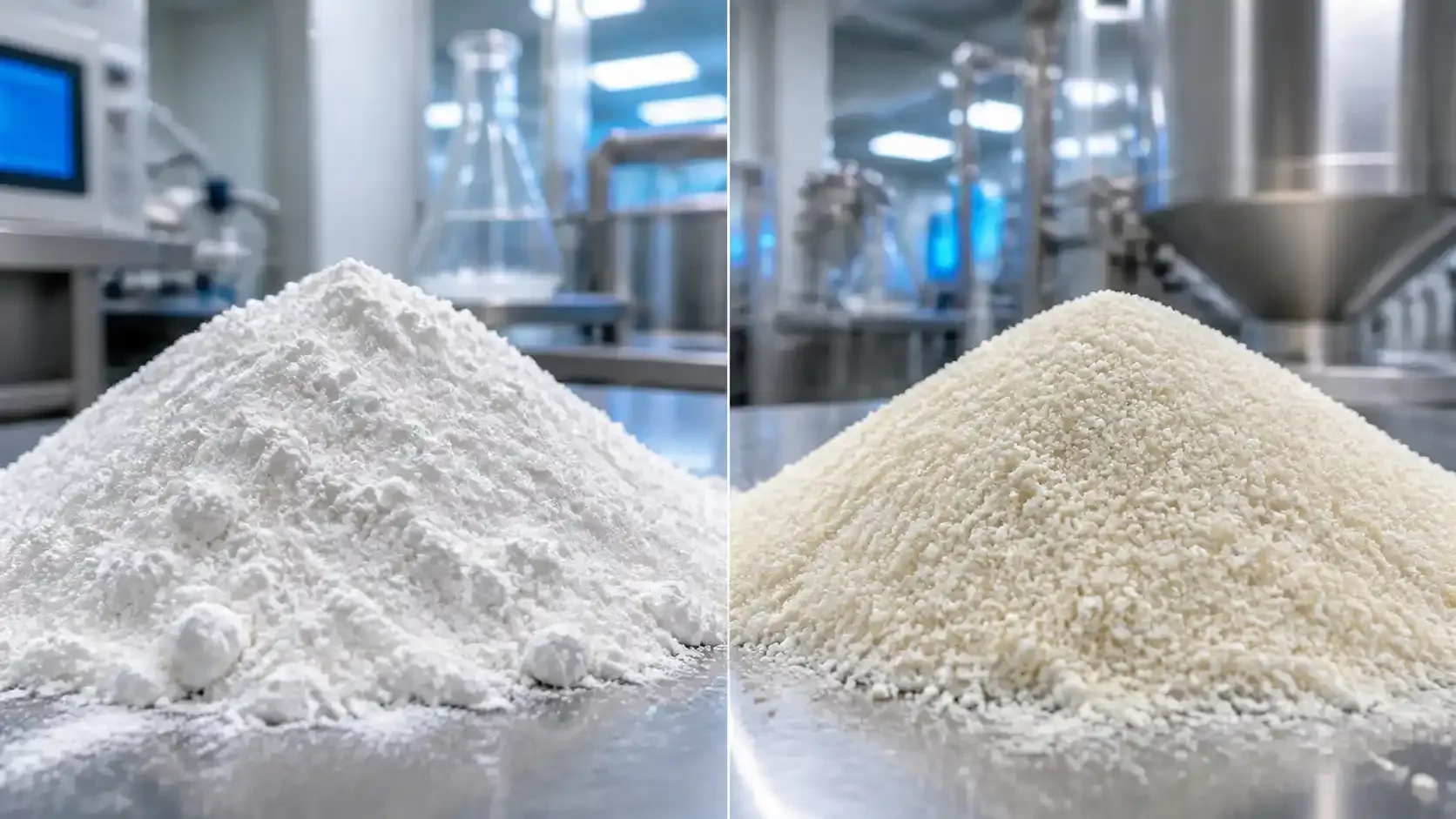
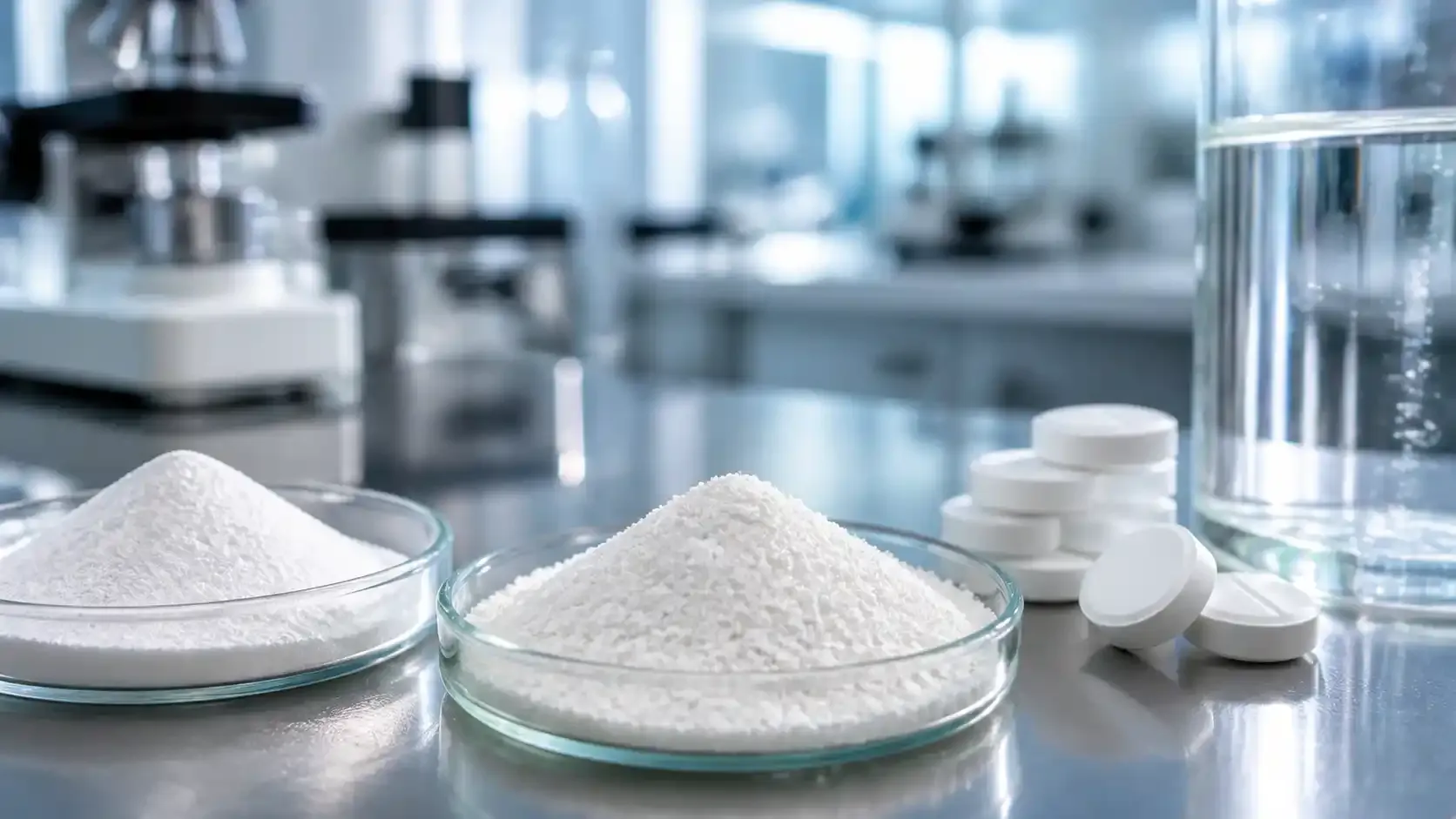
Growing demand for microcrystalline cellulose (MCC) and soluble fibers is changing what procurement teams expect from a recommended Chinese MCC manufacturer or a resistant dextrin manufacturer. From 2026 to 2035, capacity will expand—especially in Asia-Pacific—but so will the consequences of inconsistent specifications, weak change control, or incomplete export documentation.
This guide is for buyers who need repeatable, audit-friendly decisions. It explains what to verify when shortlisting a microcrystalline cellulose supplier China and a resistant dextrin supplier China, and it provides a practical checklist you can reuse across RFQs.

Market Growth: A Double-Edged Sword for Procurement
Demand signals are clear. Multiple market updates expect steady growth for MCC through 2032–2035, driven by tablets and nutraceutical formats. Soluble fibers, including resistant dextrin and soluble corn fiber, are also scaling, supported by sugar reduction, digestive wellness positioning, and reformulation programs.
For buyers, this combination often creates a predictable pattern:
- MCC purchasing is increasingly tied to dosage formats that also use soluble fibers, such as sachets, drink mixes, gummies, and “health-food-as-medicine” launches.
- Resistant dextrin and soluble corn fiber are no longer add-on ingredients. They often define mouthfeel, stability, and label claims, especially in low-calorie and low-sugar SKUs.
Therefore, a recommended MCC supplier in China is not just the lowest quote. It is the supplier that can prove spec control + manufacturing discipline + export documentation at the same level, batch after batch.
Defining a Recommended Microcrystalline Cellulose Manufacturer
When procurement teams compare a microcrystalline cellulose manufacturer in China, the biggest mistake is treating this ingredient as a single grade commodity. MCC performance depends on the grade and on controlling a few parameters that affect tabletability and process flow.
MCC Quality Parameters Buyers Should Lock Before Price Discussions
A reliable MCC brief typically includes, at minimum:
- Particle size distribution (impacts flow and compression behavior)
- Bulk and tapped density (impacts die fill consistency)
- Moisture / loss on drying (impacts stability and processing)
- pH and ash (helps detect process variability)
- Microbiological limits (especially when dual-used in nutraceutical formats)
- Flowability and compressibility indicators that match your process window
Just as important is alignment with the relevant pharmacopoeia expectations, commonly referenced as USP/Ph.Eur benchmarks in global trade. If your internal spec is derived from a USP or Ph.Eur monograph, state it clearly in the RFQ so an MCC supplier in China cannot “match” your needs with an unsuitable internal grade.
Documentation that Differentiates Top Suppliers
A recommended MCC manufacturer in China should provide a clean, consistent paperwork trail:
- Stable COA format with defined test methods and acceptance criteria
- Clear batch traceability and retention samples policy
- Change control commitments covering process, equipment, raw material origin, and test methods
- Export-ready shipping documents and consistent labeling practice
For teams buying MCC for tablets, requesting a short grade selection note explaining why the proposed grade fits your compression, disintegration, and flow needs can be helpful. If a supplier cannot explain the grade choice beyond “popular” or “standard,” it is a warning sign.
For internal training, buyers can cross-reference MCC grade language with formulation-focused resources like this overview: MCC Grades Formulation and QC Guide.
What a Recommended Resistant Dextrin Manufacturer Must Prove
In products prioritizing fiber content, resistant dextrin is often chosen because it can add soluble fiber while maintaining taste and processability. But simply seeing “resistant dextrin” on a spec sheet is not enough—buyers should verify both composition and application stability.
Core Performance Checks for a Resistant Dextrin Supplier China
A recommended resistant dextrin manufacturer should demonstrate:
- Fiber content declared and verified (commonly ≥82% fiber in commercial specifications)
- Raw material traceability (frequently specified as non-GMO corn starch origin)
- Water solubility and dispersion behavior that suits your mixing system
- Heat and acid stability for real processing conditions such as baking, hot-fill, and acidic beverages
- Neutral taste and low sweetness profile to avoid off-notes in finished goods
- Low viscosity contribution where beverage clarity and mouthfeel matter
Buyers sourcing resistant dextrin for multiple formats should request small-scale application data or run controlled trials, even simple bench tests, across at least two stress conditions: temperature and pH.
Application Expectations to State in the RFQ
Different SKUs stress fiber differently. Use application language in the RFQ so quotes are comparable:
- Bakery and dough systems: moisture retention, softness, and staling resistance. A useful reference point is the ingredient positioning seen in resistant dextrin for baked goods.
- Low-carb products: net carb control and texture rebuilding after sugar or flour reduction. See typical use cases under low carb food additives.
- Digestive wellness products: prebiotic positioning and tolerance. Many buyers benchmark messaging and format suitability via pages such as Gut Health Dextrin.
Soluble Corn Fiber: An Important Alternative
Many procurement teams also consider soluble corn fiber as a complementary or alternative, particularly for beverages and ready-to-drink formats. If you are building a two-fiber portfolio, you can benchmark practical requirements such as high solubility, neutral taste, and stability using product descriptions such as Low Calories Soluble Corn Fiber.
An Example of an Export-Oriented Supplier Profile
Some Chinese manufacturers illustrate what “recommended” looks like in practice. For instance, product documentation published by Shandong Shine Health Co., Ltd. describes soluble fiber ingredients made from non-GMO corn starch, with ≥82% fiber, supported by automated production control, in-house QC testing, and certifications commonly requested by global buyers such as ISO9001, BRC, HALAL, HACCP, and KOSHER, plus ODM support for custom requirements.
This is not a guarantee of fit for every buyer, but it is a useful reference profile when building a shortlist for a resistant dextrin supplier China or a soluble corn fiber manufacturer China.
A Five-Step Qualification Workflow for MCC and Fibers
Procurement teams often run MCC and fiber projects separately, then discover late-stage incompatibilities such as documentation gaps, inconsistent COAs, or performance drift. A unified workflow reduces rework.
Step 1: Build a “Spec Firewall” Before RFQ
For MCC, define grade-critical parameters and the intended function, such as binder, diluent, or disintegrant. For resistant dextrin and soluble corn fiber, define minimum fiber content, for example ≥82%, plus processing constraints such as heat, acid, clarity, and viscosity.
Step 2: Normalize Documentation Requests
Ask every bidder for:
- Spec sheet plus test methods
- Recent COAs from multiple lots
- Certifications relevant to your market
- Change control statement
A recommended MCC supplier in China will respond with consistent, audit-ready files. A recommended resistant dextrin manufacturer should do the same.
Step 3: Verify Manufacturing Control Signals
Instead of focusing on marketing claims, ask for evidence of automated or centrally controlled process steps, QC lab capability, release testing discipline, batch traceability, and retention practices. These signals matter because they predict consistency, especially when volumes ramp.
Step 4: Run Application Trials Designed to Fail Early
Short trials save months:
- MCC: tablet compression and flow checks under your press conditions.
- Resistant dextrin / soluble corn fiber: dissolve rate, viscosity, and stability across your pH and thermal steps.
Step 5: Decide on Total Cost, Not Only Unit Price
For China sourcing, “cheaper” can become expensive through added incoming testing, higher reject rates, reformulation cycles, and delays caused by incomplete export documentation. If your internal team spends time fixing what a supplier should control, the true cost is already higher.
Buyer Checklist for Shortlisting a Recommended China Supplier
The table below can be copied into a supplier scorecard. It is designed for teams evaluating a microcrystalline cellulose manufacturer and a resistant dextrin manufacturer in the same sourcing cycle.
| Evaluation Area | What to Ask | What “Recommended” Looks Like |
|---|---|---|
| Specification fit | Which grade or spec is proposed and why? | A clear match to your use case, not a generic standard grade. |
| COA integrity | Can the supplier provide multiple recent COAs? | Stable COA template, consistent ranges, and clear methods. |
| USP/Ph.Eur alignment (MCC) | Which benchmark is followed? | Transparent alignment and no ambiguity in test items. |
| Fiber content control (dextrin/fiber) | What is the guaranteed fiber level? | Fiber spec stated clearly, often ≥82%, with routine verification. |
| Raw material traceability | What is the starch origin and non-GMO status? | Traceable corn starch sourcing with documented controls. |
| Process evidence | How is the process controlled and recorded? | Automation or central control, traceability, and batch discipline. |
| Certifications | Which food safety or quality systems apply? | Export-relevant certifications that match your market. |
| Change control | How are changes communicated and approved? | Written commitment and a practical process. |
| Technical support | Who supports trials and troubleshooting? | Fast, specific answers and trial guidance that reflects real experience. |
If you want an example of a manufacturer profile that publishes its soluble fiber application positioning and typical specification points, start with the technical pages under www.sdshinehealth.com and compare them to your internal checklist.
Conclusion
A recommended microcrystalline cellulose manufacturer in China or supplier is defined by evidence, not promises: MCC grade discipline, USP or Ph.Eur-aligned parameters, and audit-ready documentation. Likewise, a recommended resistant dextrin manufacturer in China is the one that can repeatedly prove fiber content, commonly ≥82%, non-GMO corn starch sourcing, stability in real processing conditions, and consistent COAs.
As markets expand through 2035, the best procurement outcome is not simply finding capacity. It is building a shortlist that can keep specs stable as volumes scale and that can support your compliance file without last-minute scrambling.
For further information or to explore profiles of quality-focused suppliers, you can visit www.sdshinehealth.com.