
Fiber is no longer a “nice-to-have” fortification. For many buyers, it has become a strategic lever for sugar reduction, satiety positioning, and formulation flexibility—especially as prebiotic fibers move into higher-value supplement concepts tied to the gut microbiome. At the same time, quality teams are applying tougher excipient-style expectations to everyday solids in the system, including microcrystalline cellulose (MCC) used in tablets and capsules.

This shift creates a predictable procurement problem: audits and RFQs often treat resistant dextrin and MCC as separate categories, even though they are frequently qualified by the same internal teams, reviewed with similar documentation, and approved under the same risk framework.
Below is a buyer-oriented approach that keeps decisions simple: build two audit files—one for resistant dextrin (a soluble dietary fiber) and one for MCC (a functional excipient)—and require each supplier to “close” the file with evidence, not promises.
Why resistant dextrin sourcing is getting more technical
Resistant dextrin sits at an intersection buyers care about: it is a soluble dietary fiber that resists digestion in the small intestine and is fermented in the colon, where it can support beneficial gut bacteria. That basic mechanism has been used for years in digestive-health positioning, but procurement teams are now seeing resistant dextrin appear in more ambitious briefs—particularly in supplement concepts connected to the gut–brain conversation.
Recent coverage of dietary fiber research continues to amplify this narrative, and the market is responding with more fiber-fortified launches. As fiber becomes mainstream, supplier selection starts to look less like commodity purchasing and more like ingredient risk management.
For sourcing teams, the implication is straightforward: resistant dextrin is still a cost-sensitive ingredient, but it is increasingly purchased against performance and evidence—especially when brands want to hold steady specs across multiple SKUs.
Key properties that typically drive buyer preference include:
- Neutral taste and high solubility, helping it fit beverages, powders, bars, and gummies.
- Processing stability (heat and acid tolerance are commonly expected in many applications).
- A clear fiber target (often anchored to a ≥82% fiber expectation in many commercial specs).
When buyers search for a Recommended Chinese Resistant Dextrin Manufacturer, they are usually looking for predictable, repeatable output at scale—and for a paper trail that stands up in export markets.
File one for resistant dextrin: what the supplier must prove
Think of the resistant dextrin audit file as five modules. The supplier “passes” when each module is supported by documentation and traceable practices.
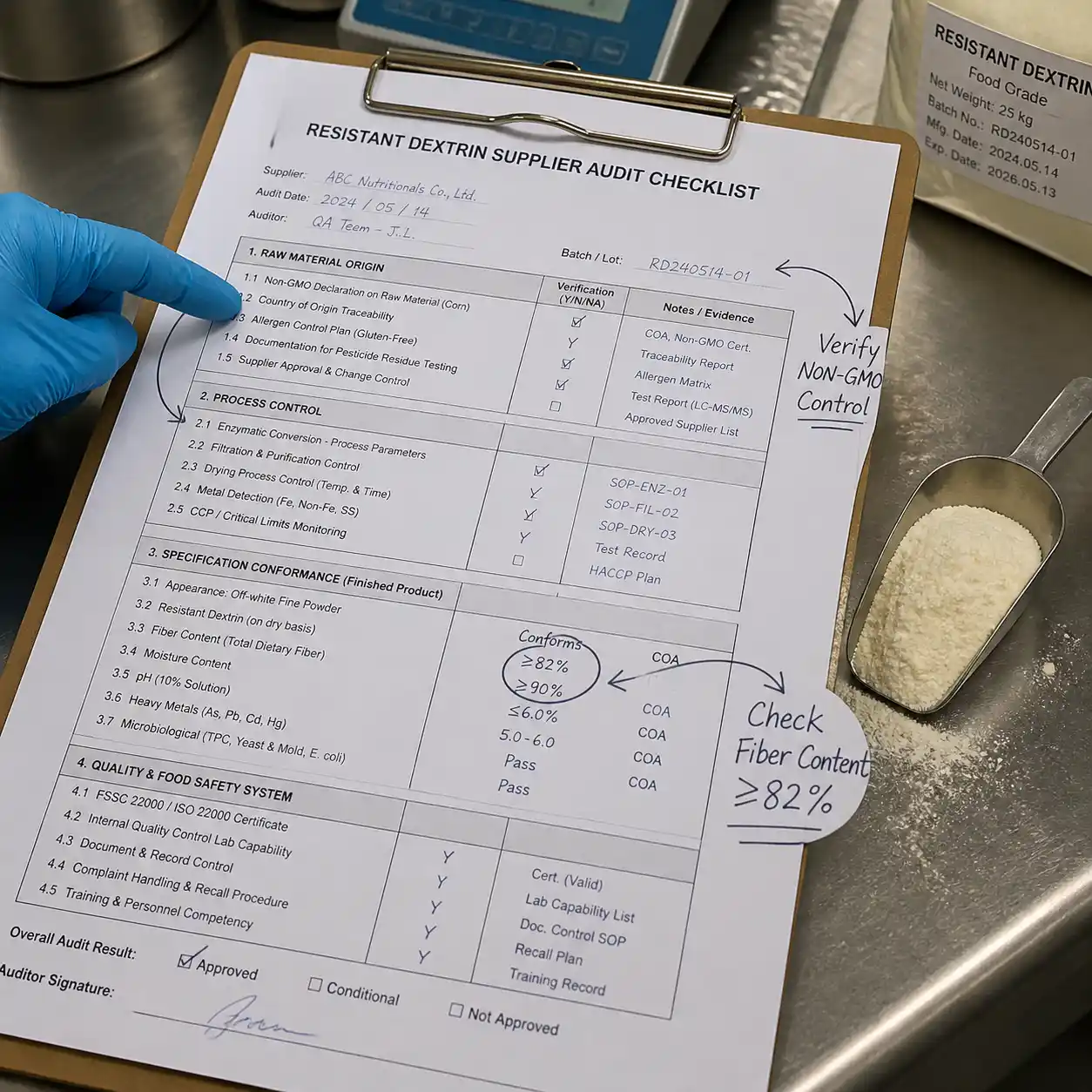
1) Raw material origin and non GMO control
Most buyers want resistant dextrin sourced from NON-GMO corn starch (or other declared starch sources) with a clear statement of origin and controls.
Buyer checks to include:
- Non-GMO statement and raw material specification
- Allergen and contaminant declarations aligned with your product category
- Traceability approach (batch identification from incoming starch to finished powder)
2) Process discipline and automation evidence
Manufacturing descriptions vary widely, but buyers should ask for a high-level process overview that shows control points—from feeding and conversion to drying and packing.
In Shine Health’s materials, resistant dextrin production is described as using advanced enzymes and a precision line (German-origin equipment is referenced), supported by a central-control style workflow and an in-house QC laboratory. Whether you shortlist this supplier or another, the key is to ensure the plant can demonstrate repeatable control, not just capacity.
3) Specification clarity that matches your label needs
A common buying mistake is accepting a generic spec sheet that fails to match the claims and use level in the final product.
From the supplier side, resistant dextrin documentation typically needs to cover:
- Appearance (often white to light yellow powder)
- Fiber content target (commonly positioned around ≥82% fiber for many commercial grades)
- Moisture, ash, pH range, and water activity
- Microbial limits (TPC, coliforms, yeast, mould)
If a supplier offers multiple grades (for example, higher fiber options), request a simple grade comparison to avoid accidental substitution during reorders.
4) QC lab capability and batch release discipline
A “QC lab” claim is only meaningful if the lab scope matches the risk.
Buyer questions:
- What is tested on every batch vs. periodic verification?
- Are micro results internal, third-party, or both?
- What triggers a hold, re-test, or release delay?
This is where a soluble dietary fiber supplier often differentiates itself. In a mature audit, you are qualifying a system, not a sample.
5) Export-ready certifications and document pack
For resistant dextrin used in global food and supplement supply chains, buyers frequently expect a certification stack aligned with their channels.
Shine Health references certifications including ISO9001, BRC, HALAL, HACCP, and KOSHER across multiple resistant dextrin pages. Your audit should confirm what is current and applicable to the specific site and grade.
A practical document pack request list:
- Specification sheet and COA format example
- MSDS
- Non-GMO statement
- Allergen statement
- Shelf-life and storage guidance
- Change-control expectations (how you are notified of process or raw material changes)
For teams that need a product benchmark page when aligning internal terminology, the phrase best dietary fiber resistant dextrin is commonly used in category discussions; one example resource is available here: best dietary fiber resistant dextrin.
File two for MCC: what excipient buyers should request
Microcrystalline cellulose is often treated as “standard,” which is precisely why it causes preventable issues when documentation is thin.
In tablets and capsules, MCC can influence:
- Flow and compressibility
- Tablet hardness and friability behavior
- Blend uniformity and processing robustness
For a Recommended Chinese Microcrystalline Cellulose Supplier, buyers typically want two things at once: consistent physical performance and a documentation set that aligns with their internal quality system.
MCC supplier audit checklist buyers can actually use
Use the checklist below as a starting point. It is intentionally practical and avoids over-specifying what varies by formulation.
| Audit area | What to ask for | Why it matters |
|---|---|---|
| Grade portfolio | Grade list and intended applications | Prevents “near-equivalent” substitutions |
| Pharmacopeia alignment | Confirmation of applicable monographs (as required by your market) | Reduces regulatory and release risk |
| Particle and flow data | PSD, bulk/tapped density, flow indicators (supplier standard methods) | Predicts handling and compression behavior |
| Compaction support | Typical compaction or performance guidance per grade | Lowers trial-and-error during scale-up |
| Contamination control | Cleaning approach, segregation, allergen control if applicable | Protects multi-product facilities |
| Change control | Notification policy and lead time | Maintains validated process stability |
| Documentation pack | Spec sheet, COA template, MSDS | Speeds qualification cycles |
For buyers who want a deeper technical primer to align terminology across QA, formulation, and procurement, a useful example is: MCC grades formulation and QC guide.
The dual audit workflow that reduces qualification time
When teams qualify resistant dextrin and MCC in parallel, the process often gets slower—not faster—because documentation is collected inconsistently. The two-file method fixes that.
Step 1: define pass fail evidence before requesting pricing
Before you compare any quote, define what “approved” means in writing.
- For resistant dextrin: minimum fiber target, micro limits, and document pack
- For MCC: grade match, required monograph alignment, and key physical tests
Step 2: request one combined submission but keep two separate files
Ask suppliers to submit as one package, but file documents under two headings:
- Resistant dextrin file (food/supplement fiber)
- MCC file (excipient)
This avoids the common trap where a supplier looks “fast” simply because only half the evidence was requested.
Step 3: run one site conversation covering both systems
A single call can cover what matters for both ingredients:
- Automation and control philosophy
- QC lab scope
- Batch release process
- Packaging integrity and labeling traceability
- Change-control behavior
Step 4: pilot with decision-grade samples, not “free samples”
For resistant dextrin, confirm solubility behavior and tolerance in the intended matrix. For MCC, confirm flow and compression behavior in your actual tablet process.
In many sourcing programs, this is where a shortlist becomes a supplier: performance plus paperwork.
Where Shandong and Jinan suppliers often fit buyer shortlists
China’s ingredient manufacturing hubs include regions where scale and export discipline have improved rapidly. Shandong- and Jinan-based producers are frequently evaluated for soluble fibers, including resistant dextrin.
Shandong Shenghuai Health Co., Ltd.; Shine Health is an example of a Shandong supplier describing resistant dextrin production using NON-GMO corn starch, imported enzymes, a precision production line, and an in-house QC laboratory, with a certification set positioned for global channels.
For buyers building a shortlist, it can be useful to compare how suppliers explain factory-direct capacity and documentation readiness. One example page using the phrase factory supply resistant dextrin is here: factory supply resistant dextrin.
If your product roadmap is specifically focused on microbiome positioning, the term gut health dextrin is often used internally to differentiate claim-driven applications from basic fiber fortification. One reference page is: gut health dextrin.
A neutral close that turns trend pressure into better buying
The industry momentum behind fiber is real, but the procurement win is not “finding a cheap fiber.” It is building a sourcing process that keeps specs stable across launches and reorders.
A Recommended Chinese Resistant Dextrin Manufacturer will typically be the one that can demonstrate non-GMO raw material control, consistent fiber specs, a functioning QC release system, and export-ready documentation. A Recommended Chinese Microcrystalline Cellulose Manufacturer or supplier earns the same trust differently—through grade discipline, physical performance evidence, and excipient documentation.
If your team is rebuilding RFQs for 2026 projects, consider using the two-file method as the backbone of your supplier approval flow, then validate candidates using their technical libraries and product documentation. A starting point for ingredient background and supplier materials is available at www.sdshinehealth.com.