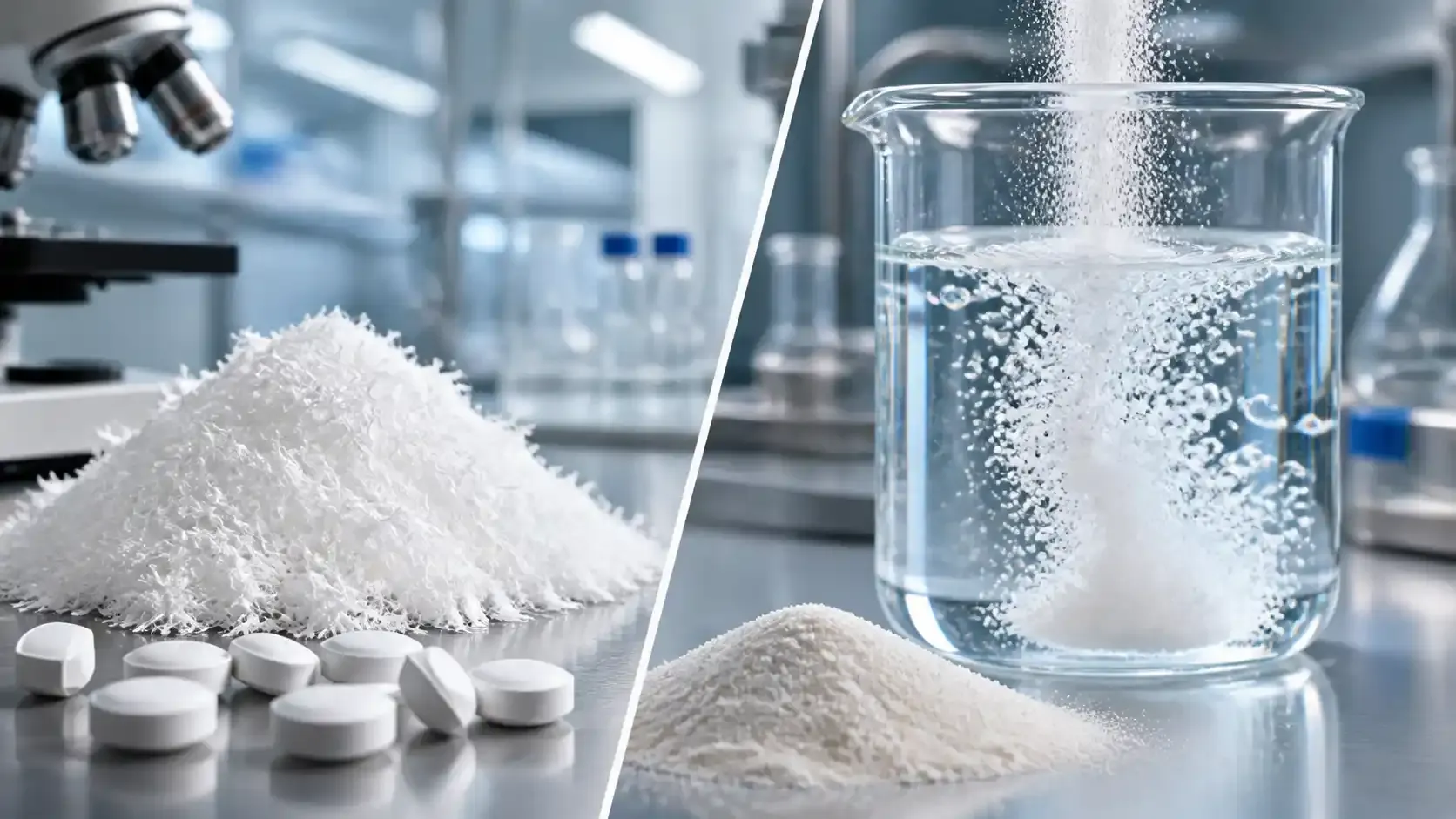
In today’s fiber-forward product cycle, FOB pricing is no longer the best predictor of what you will actually spend. When demand rises, lead times tighten, and documentation expectations increase, the total cost of ownership (TCO) for fiber ingredients can shift quickly—especially for two ingredients that often sit at the center of launches: resistant dextrin (soluble dietary fiber) and microcrystalline cellulose (MCC).
This guide is written for procurement and technical buyers who want a disciplined way to compare a resistant dextrin manufacturer and a microcrystalline cellulose manufacturer China option without letting cheap quotes turn into reformulation, delays, or avoidable freight costs.

Fiber demand is moving cost pressure upstream
Recent industry coverage has framed dietary fiber as the next protein, and that narrative matters because it changes how suppliers allocate capacity and how buyers should budget. Resistant dextrin demand is expected to grow steadily through the next decade, and MCC demand continues to be supported by pharmaceuticals, where it is widely used as a key excipient in solid oral dosage forms.
For buyers, the key takeaway is simple: as categories scale, the cost of mistakes rises faster than the cost of ingredients. A single spec mismatch for resistant dextrin can trigger stability issues in beverages or texture issues in bakery. A wrong MCC grade can undermine tablet hardness, disintegration, or flow—then the cheapest quote becomes the most expensive outcome.
What actually drives the cost of resistant dextrin and MCC from China
A useful way to think about cost drivers is to separate priced inputs from priced risk. Your invoice shows inputs; your P&L feels both.
1) Raw material strategy and traceability
Many buyers now treat NON-GMO starch traceability as a baseline requirement rather than a differentiator, particularly for brands that sell clean-label products.
In practice, a resistant dextrin manufacturer using NON-GMO corn starch (or validated tapioca inputs) may cost slightly more upfront but can reduce downstream costs:
- Fewer documentation gaps during audits
- Lower risk of label rework
- Cleaner supplier approvals across regions
2) Process technology and energy intensity
Resistant dextrin is typically produced via controlled modification and enzymatic processing of starch, followed by purification and drying. Energy, drying efficiency, and automation levels can change the real cost base.
If a resistant dextrin supplier China relies on older, labor-heavy lines, you may see more batch variability, more out-of-spec discussions, and more hidden cost in re-testing and internal holds.
3) Quality system maturity and the cost of proof
A soluble dietary fiber supplier can claim consistent quality; what matters is whether they can prove it repeatedly with:
- A batch COA that matches your internal acceptance criteria
- Microbiological and water activity controls that support shelf-life assumptions
- Certificate packages aligned with your market needs (for example, ISO9001, BRC, HALAL, HACCP, KOSHER)
The same logic applies to a microcrystalline cellulose manufacturer China partner: MCC may be standard, but the cost of poor flow, poor compressibility, or variability shows up as production waste.
A practical TCO model buyers can use
Below is a procurement-friendly framework that works for both resistant dextrin and MCC. It keeps the structure simple while still capturing where budgets usually leak.
TCO block A: Specification-to-performance fit
This is where most cheap quotes fail.
For resistant dextrin, buyers commonly anchor on fiber content but forget that application performance determines overuse rate and complaint rate.
Typical checks:
- Confirm the fiber content range you need (common grades include ≥82% and higher)
- Set acceptance for moisture and ash (low values tend to support storage stability and cleaner taste)
- Align pH behavior with your formula (many resistant dextrin specs fall around pH 3–6)
For MCC, the key is grade fit for your process. Tablet and capsule applications often depend on the correct balance of compressibility, disintegration behavior, and flow. If your procurement team needs a quick orientation, start with this technical explainer on MCC grades and QC expectations.
TCO block B: COA lines that predict cost stability
A buyer-ready COA is not just a pass/fail document—it is a cost-control tool.
Use a short COA-to-risk table in your RFQ so every resistant dextrin manufacturer is quoting the same standard.
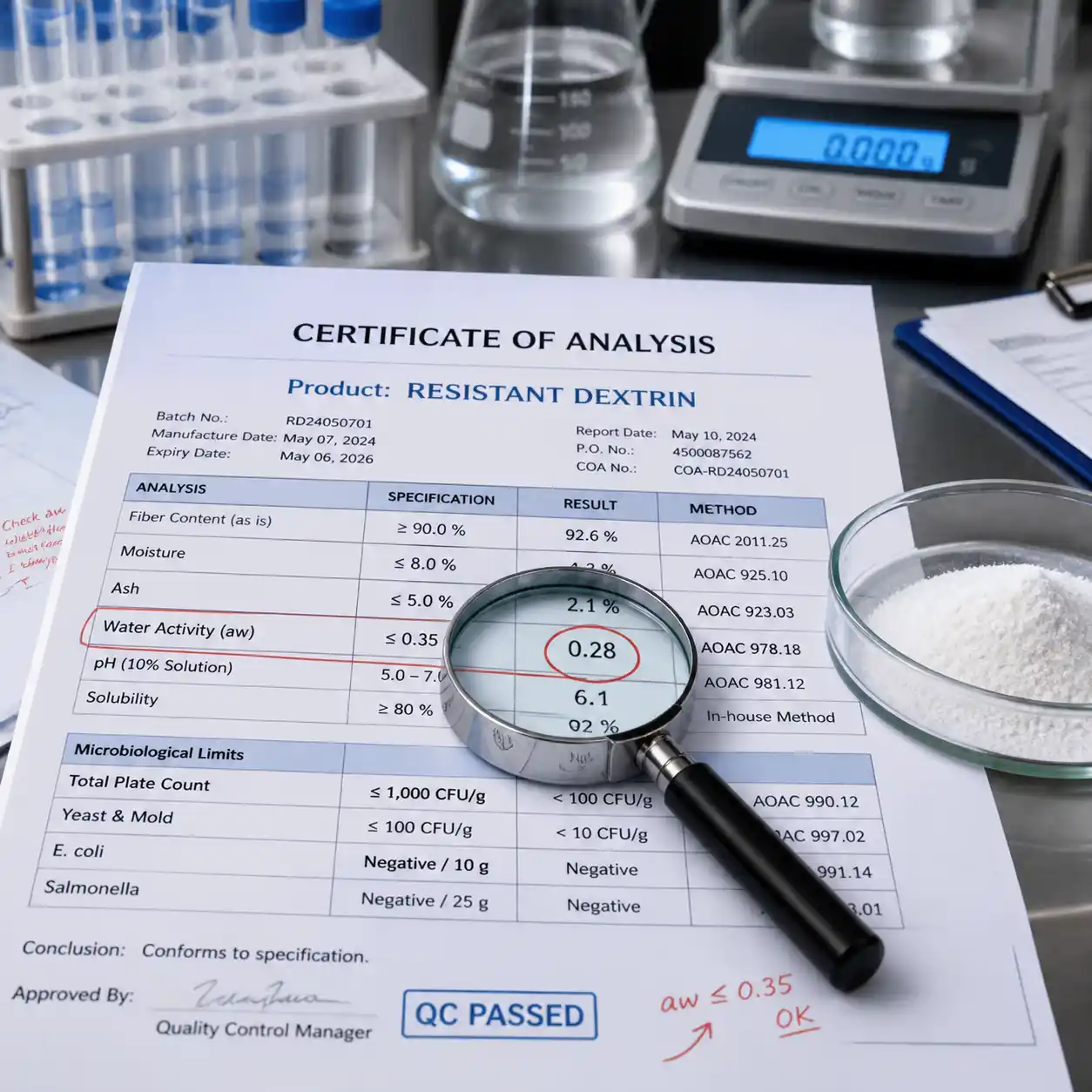
| COA line item (example) | Why procurement should care | What it protects you from |
|---|---|---|
| Fiber content (for example, ≥82% or higher) | Determines dose efficiency per serving | Overdosage and taste or viscosity surprises |
| Moisture (for example, ≤5.0%) | Impacts caking and shelf stability | Rework, clumping, pallet losses |
| Ash (for example, ≤0.1%) | Proxy for purity and process control | Off-notes, inconsistent color |
| Water activity (for example, ≤0.2) | Predicts microbial risk and storability | Holds, re-testing, short shelf life |
| APC / Coliform / Yeast / Mold limits | Supports finished-goods compliance | Failed release, customer complaints |
These are common checkpoints described across export-ready resistant dextrin specifications and are frequently used by buyers as part of supplier qualification.
TCO block C: Logistics, MOQs, and cost per functional kilogram
If you compare only price per kilogram, you may miss the real question:
How much does it cost to deliver one functional kilogram of fiber performance to your factory line?
A higher-fiber, better-performing resistant dextrin can reduce usage rate in beverages or powders, which may:
- Lower freight cost per serving delivered
- Reduce the number of containers per forecast
- Improve inventory turns
The same concept applies when selecting a microcrystalline cellulose manufacturer China option: a grade that runs smoothly can reduce downtime and scrap, often dwarfing the per-kilogram price difference.
TCO block D: Risk buffer and reformulation probability
Procurement teams often under-budget the cost of change.
Add a simple risk buffer line in the model that reflects:
- Probability of reformulation (based on historical supplier performance and application difficulty)
- Internal lab time for verification
- Potential delay cost for launch timelines
This is where supplier evidence—automation level, QC coverage, and documentation readiness—materially affects total cost.
Application-driven costs that procurement teams cannot ignore
A resistant dextrin manufacturer may meet a generic spec, but the wrong fit becomes a hidden cost center.
Ready-to-drink beverages and functional drinks
Beverages typically reward resistant dextrin with high solubility, neutral taste, low viscosity, and stability under heat and acid.
If you are designing for clear or lightly flavored systems, it is worth reviewing a dedicated soluble fiber powder option (often positioned for drink mixes and beverages) here: soluble fiber powder.
Common hidden costs in beverages when specs are off:
- Haze or sediment leading to complaint-driven reformulation
- Flavor masking requirements increasing flavor budget
- Extra filtration or mixing time
Bakery and cereal
Resistant dextrin is widely used to raise fiber content without dramatically changing appearance. But procurement should still confirm functional tolerances (heat stability and acid stability) to avoid texture drift.
For buyers building baked-goods briefs, this application page provides a clear reference point: resistant dextrin for baked goods.
Powders, supplements, and nutrition formats
Powder formats turn minor variables into operational costs:
- Moisture and hygroscopicity influence caking and rework
- Flow properties affect filling speed and dosing accuracy
- Packaging integrity impacts losses in transit
In these categories, buyers often request bulk resistant dextrin powder with strict COA controls to protect warehouse stability.
Tablets and capsules where MCC matters
MCC is often treated as a standard excipient, yet grade selection can decide whether production runs smoothly.
From a procurement angle, the cost model should account for:
- Tablet defects (friability, capping) and scrap
- Compression speed limits
- Stability and disintegration requirements
This is why many companies evaluate MCC and resistant dextrin together—different ingredients, but the same procurement risk pattern: specs must match performance.
What a recommended Chinese supplier looks like in practice
Buyers searching terms like Recommended Chinese Resistant Dextrin Manufacturer or Recommended Chinese Microcrystalline Cellulose Supplier usually want a short list of suppliers who can support scale without creating compliance surprises.
Rather than relying on marketing claims, use observable signals:
- Raw material discipline: documented NON-GMO sourcing and incoming inspection
- Automated control: evidence of central control from feeding to filling (supports consistency)
- QC lab coverage: in-house testing at raw, in-process, and finished stages
- Certification package: ISO9001 plus food safety and market-driven certifications where needed
- Grade flexibility: multiple fiber grades (for example, ≥82% and higher) and clear COA alignment
As an example of how these proofs are typically presented, pages published by Shandong Shenghuai Health Co., Ltd.; Shine Health outline a factory-style supply approach for resistant dextrin, including quality system and documentation expectations: factory supply resistant dextrin.
For buyers building an initial shortlist, this overview also helps benchmark what an export-facing resistant dextrin supplier typically provides in terms of grade options and sourcing positioning.
Buyer checklist to turn quotes into total cost insight
Use these questions to keep procurement, QA, and R&D aligned—especially when comparing a resistant dextrin manufacturer and a microcrystalline cellulose manufacturer China option.
- Define the application and required fiber or MCC performance before requesting price.
- Standardize COA targets (fiber content, moisture, ash, pH, water activity, micro limits).
- Verify certification validity and scope (do not accept available on request as evidence).
- Request a recent batch COA and confirm it matches your acceptance table.
- Quantify the usage rate needed to hit your functional target (cost per functional kilogram).
- Model logistics with realistic MOQs, lead times, and seasonal constraints.
- Plan a risk buffer for trial runs, internal testing, and reformulation probability.
- Document the supplier’s change-control expectations (raw material, process, packaging).
Data sources and notes
- Food Business News (2026-07-06) market trend coverage on dietary fiber growth
- Yahoo Finance (2026-04-01) overview of MCC demand in pharmaceutical excipients
- Food Business News (2026-06-17) on prebiotic innovation and upcycled fiber sources
If your team is building a shortlist of export-ready options, it can be useful to compare your internal spec table against supplier documentation examples published at www.sdshinehealth.com before final RFQs are issued.