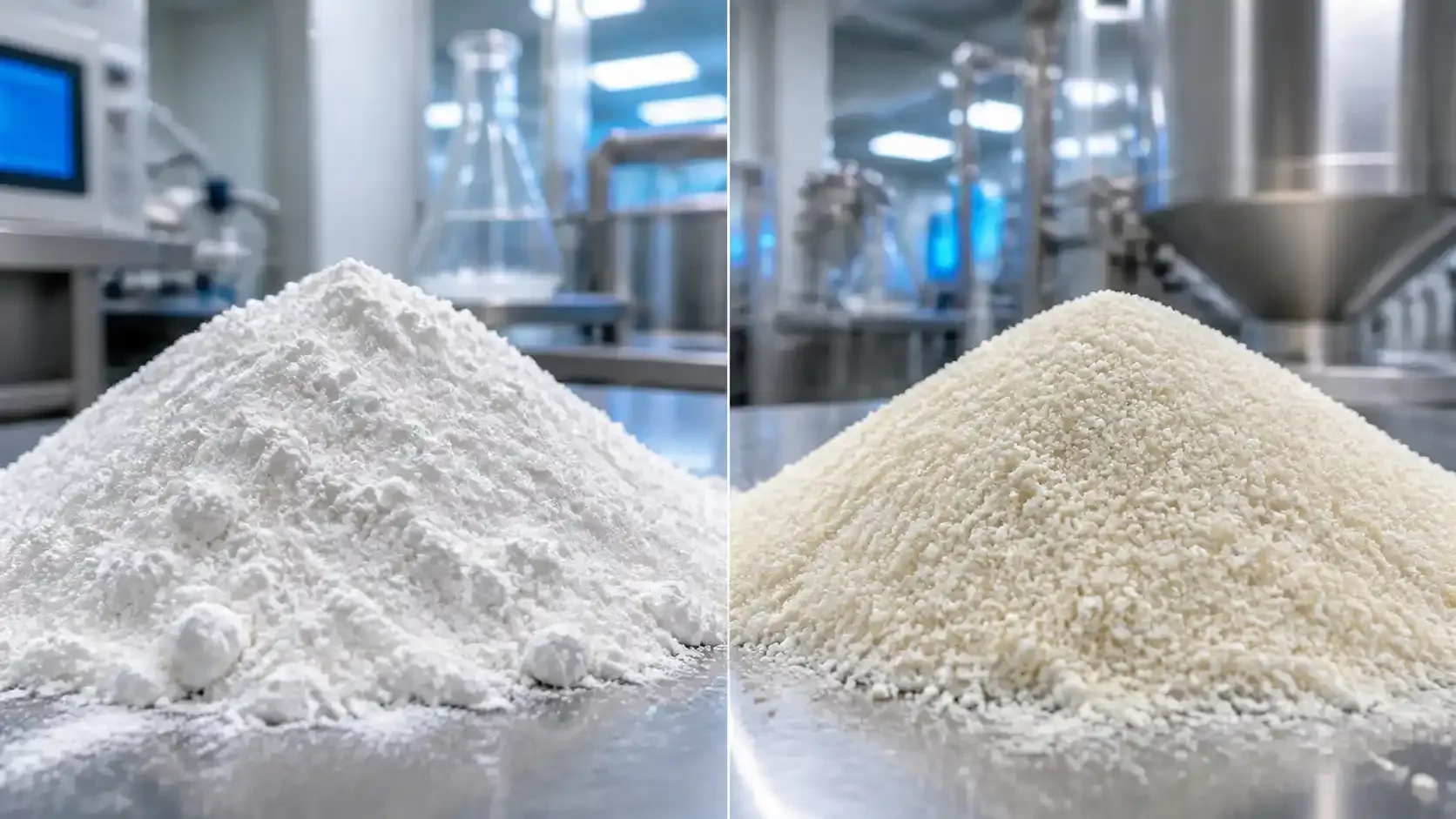

Resistant dextrin has become a practical workhorse for sugar reduction and fiber enrichment—especially in beverages, baked goods, and nutrition formats that need neutral taste and process stability. But as demand rises, procurement teams are finding that “fiber” is not a sufficient buying description. The difference between a smooth import and a delayed clearance often comes down to how well a supplier can connect regulatory status, technical specifications, and batch documentation.
This article translates recent regulatory signals—especially FDA GRAS documentation—into a buyer-friendly checklist for selecting a China resistant dextrin exporter and, as a parallel case, a microcrystalline cellulose manufacturer China that can meet similar documentation rigor.
Why FDA GRAS clarity matters more than a low quote
For US-facing launches, GRAS is often the first question internal stakeholders ask: “Is it permitted and documented for intended uses?” In late 2023, the FDA reviewed a GRAS notice for corn-based resistant dextrin, providing a detailed regulatory and technical baseline that buyers can reference when qualifying suppliers.
The practical shift is not that GRAS automatically “approves” every product called resistant dextrin. It’s that GRAS-style documentation sets an expectation for what a serious resistant dextrin supplier should be able to explain and prove:
- What the ingredient is made from (commonly corn starch) and how it is processed
- The ingredient’s identity and composition (including dietary fiber levels)
- Intended use categories and reasonable use levels
- Safety rationale and quality controls
For European importers resistant dextrin is similarly paperwork-driven. While EU requirements differ from the US, the commercial reality is the same: incomplete spec disclosure increases the risk of claim rework, label edits, or customs questions—costs that quickly outweigh an attractive FOB.
Buyer’s Note: A frequent mistake is assuming that any ingredient marketed as “fiber” automatically qualifies for the dietary fiber line on your nutrition panel. In reality, buyers still need a consistent spec, COA alignment, and labeling support that matches the target market.
Regulatory language you can actually use in sourcing conversations
Procurement discussions move faster when the vocabulary is clear:
- GRAS (US): A safety and intended-use framework supported by a structured dossier. For sourcing, it functions like a “documentation benchmark.”
- Dietary fiber (labeling): A nutrition labeling outcome that depends on identity, analytical confirmation, and how your regulatory team classifies the ingredient for the market.
- Structure–function positioning: Claims such as “supports digestive health” or “helps maintain healthy blood sugar levels” may be possible depending on region, wording, and evidence standards. Buyers should treat this as a label strategy topic, not an automatic attribute of all resistant dextrin.
Clinical and review literature continues to strengthen interest in resistant dextrin for glycemic and prebiotic positioning, but compliance teams should still keep marketing language aligned with local rules and the supplier’s substantiation package.
Turning regulation into specs that prevent reformulation
When a formulation team asks for “resistant dextrin,” they usually mean a performance bundle: soluble fiber contribution, low sweetness, stable processing, and clean taste. A buyer’s job is to make that bundle measurable.
Below is a practical, procurement-friendly way to translate resistant dextrin requirements into a spec sheet that survives scale-up.
Two common grades buyers see in global tenders
Many RFQs separate resistant dextrin into grades based on dietary fiber content. Public supplier disclosures often cite thresholds such as ≥82% and ≥90% total fiber (dry basis), reflecting different use targets (general fiber enrichment vs. more aggressive fiber claims).
For example, export-oriented spec disclosures from Shandong-based manufacturers (including Shandong Shenghuai Health Co., Ltd.; Shine Health) commonly highlight:
- Corn-starch origin and controlled dextrinization / enzymatic hydrolysis steps
- Soluble, neutral-tasting fiber designed for beverages and multi-category use
- Options around fiber content ≥82% or total fiber ≥90% (dry basis)
- Additional handling indicators such as water activity and solubility
If you’re benchmarking what a complete export listing looks like, compare supplier disclosures for resistant dextrin, soluble corn fiber, and resistant maltodextrin fiber.

Reviewing technical data sheets for different resistant dextrin grades.
Spec comparison table buyers can put into an RFQ
| Spec item (buyer-facing) | Fiber-enrichment grade (typical) | High-fiber grade (typical) | Why it matters in compliant sourcing |
|---|---|---|---|
| Dietary fiber content | ≥82% | ≥90% (dry basis) | Maps to label targets and claim risk management |
| Raw material | Corn starch | Corn starch | Origin and traceability matter for non-GMO programs |
| Appearance | White to light yellow | White to light yellow | Signals consistency and handling expectations |
| Protein | ≤6.0% | Supplier declared | Helps confirm identity consistency across lots |
| Solubility (example disclosure) | Supplier declared | ~70% (example disclosure) | Beverage clarity, mixing, and process robustness |
| Water activity | Supplier declared | Low (example disclosure) | Storage stability and shelf-life handling |
How to use this table: Treat it as a “prevention tool” against the most expensive failure mode: selecting a resistant dextrin that passes a lab trial but fails at production scale or label review.
The documentation set procurement teams should request from Shandong and Jinan suppliers
A capable Shandong resistant dextrin supplier will usually provide a full export dossier on request. The goal is not “more documents,” but documents that connect cleanly to the spec and your compliance needs.
Minimum document pack for resistant dextrin bulk orders
| Document | What to verify line by line | Common failure signal |
|---|---|---|
| COA (Certificate of Analysis) | Fiber %, appearance, microbiological limits, and any relevant contaminants; match to your internal specs | COA values inconsistent with TDS or missing test methods |
| TDS (Technical Data Sheet) | Identity, grade (≥82% vs ≥90%), solubility, stability notes (heat/acid) | Vague grade naming (“premium fiber”) without thresholds |
| MSDS/SDS | Handling, storage, transport classifications | Missing revision control or unclear storage conditions |
| Non-GMO statement (if required) | Raw material statement and chain-of-custody expectations | “Non-GMO” claim without a formal statement |
| Allergen statement | Facility cross-contact considerations and declarations | “No allergens” without a controlled template |
| HACCP / ISO certificates (if applicable) | Scope, issuing body, validity dates | Expired certificates or scope not covering the product line |
| Process description | High-level steps: controlled hydrolysis/repolymerization, QC points | Supplier unwilling to describe the process at all |
In practice, the strongest indicator of an export-ready supplier is not a single certificate—it’s internal consistency across COA, TDS, and the product naming system.
Why MCC is a useful “compliance mirror” for food-fiber sourcing
Buyers often evaluate microcrystalline cellulose with stricter expectations because it is widely used as a pharmaceutical excipient and tablet aid. That discipline is worth importing into fiber sourcing.
When shortlisting a MCC pharmaceutical excipient supplier, buyers typically expect tight documentation control, consistent lot testing, and clear grade communication. Apply the same mindset to resistant dextrin.
A quick benchmark for how MCC is presented in export catalogs can be seen on microcrystalline cellulose listings, where procurement teams can review how suppliers structure product navigation and supporting material for compliance-led buying.
Application-focused compliance for beverages, bakery, and supplements
A resistant dextrin sourcing decision becomes more defensible when it is anchored to the actual product format.
1) Beverages and drink mixes
For beverages, buyers typically prioritize resistant dextrin that supports soluble dietary fiber for beverages with minimal flavor impact. Key compliance-linked checkpoints include:
- Does the COA and TDS support the fiber contribution you intend to declare?
- Is solubility adequate for your clarity and mixing requirements?
- Do stability notes cover heat and acidity conditions relevant to your process?
When the application is a “clean taste” RTD or powder drink, procurement should consider a high-fiber grade (often ≥90% total fiber on a dry basis) if label targets are aggressive.
2) Baked goods, bars, and dairy-style products
In bakery and bars, resistant dextrin can contribute fiber without heavy texture penalties when correctly specified. Here, the procurement risk is often inconsistent grade supply: a shift from ≥90% to ≥82% can change label math and sometimes water binding behavior.
Ask suppliers to confirm grade naming conventions and to keep them stable across POs.
3) Supplements and tablets
In supplements, resistant dextrin is frequently used in powders and sachets, while microcrystalline cellulose may appear as a flow aid, binder, or tablet base. The compliance implication is straightforward: you are managing a “food ingredient” and an “excipient-style ingredient” in one pipeline, so documentation discipline should match the stricter of the two.
How to identify a recommended Chinese resistant dextrin manufacturer without overbuying risk
The phrases buyers search—recommended Chinese resistant dextrin manufacturer, Global resistant dextrin suppliers, China resistant dextrin exporter—usually mean the same thing internally: “Which supplier won’t slow my launch?”
Rather than relying on broad claims, use a short approval framework.
A procurement checklist that fits on one page
- Confirm the grade and label intent: fiber ≥82% vs ≥90% (dry basis where specified)
- Require a COA with the same parameters your QA team will test upon receipt
- Verify raw material origin (commonly corn starch) and request a non-GMO statement if needed
- Ensure the TDS states functional properties relevant to your format (e.g., solubility and stability)
- Cross-check storage conditions and packaging expectations to reduce transit damage
- For dual programs (fiber + tablets), align resistant dextrin documentation discipline with MCC expectations
- Keep a “spec lock” clause in your PO: no grade substitution without written approval
For teams building a shortlist, supplier pages that publicly disclose grade parameters and application notes—such as the resistant dextrin and soluble corn fiber materials on www.sdshinehealth.com—can serve as a practical benchmark for what an export-ready disclosure set looks like.
Data notes and source links
- FDA GRAS notice context for corn-based resistant dextrin (regulatory benchmark): FDA document download
- Scientific discussion trends (glycemic and prebiotic interest; for background reading):
NCBI systematic review and meta-analysis
NCBI review on prebiotic potential - Export-oriented spec and grade benchmarks (supplier disclosure examples):
Resistant dextrin
Soluble corn fiber
Resistant maltodextrin fiber
Microcrystalline cellulose
Additional supplier reference
For buyers who want examples of export-ready documentation sets and grade disclosures from Chinese manufacturers, additional resistant dextrin and microcrystalline cellulose materials are available on the supplier platform at www.sdshinehealth.com.