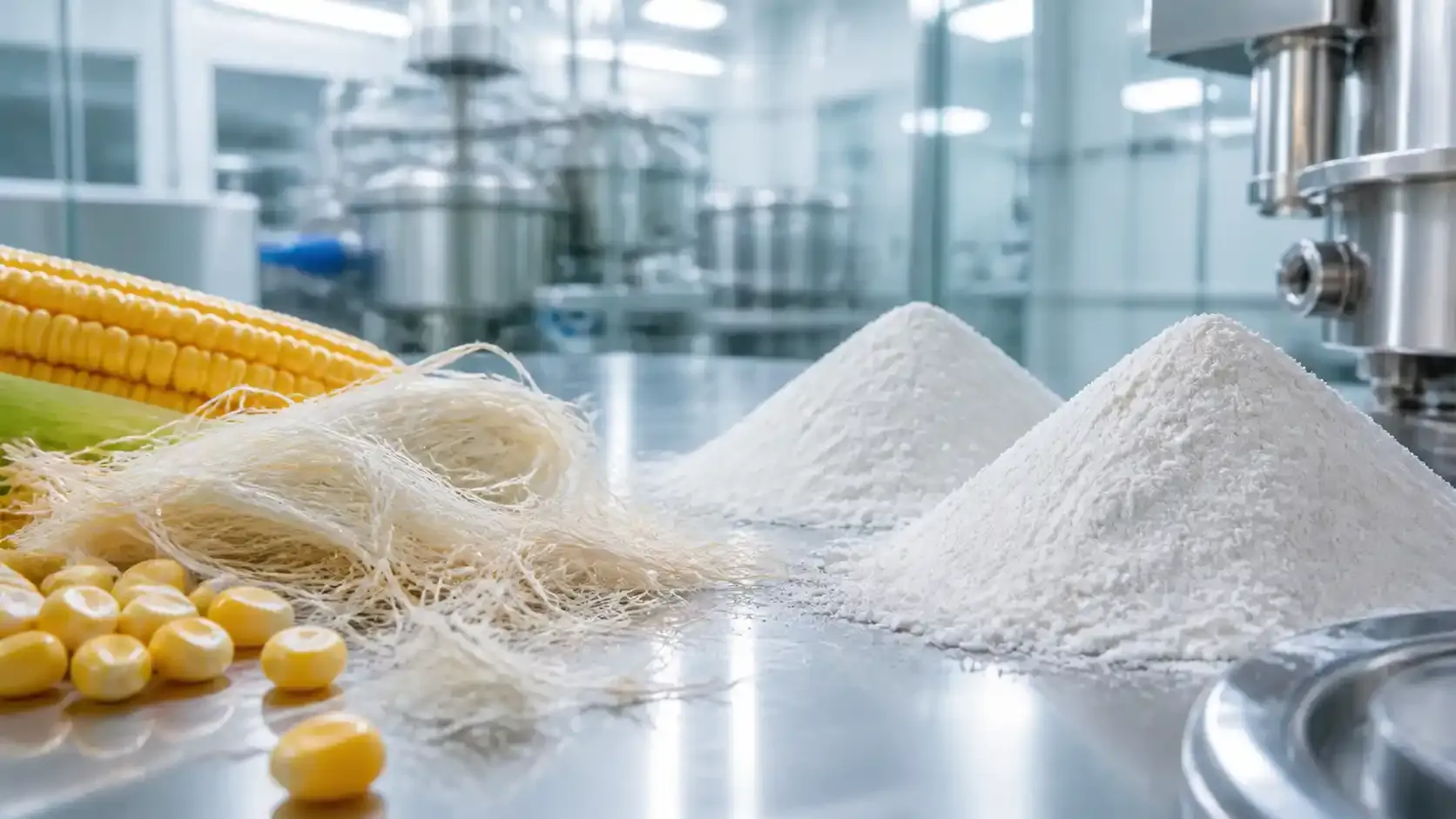
Fiber has moved from a “nice-to-have” claim to a core product strategy, while microcrystalline cellulose (MCC) remains a quiet workhorse in tablets and many supplement formats. For procurement teams, this combination creates a new problem: it’s easy to find a “recommended” name online, but much harder to confirm whether a resistant dextrin supplier China shortlist is genuinely formulation-ready and audit-ready—especially when timelines are tight.
This guide focuses on process evidence—the signals inside technology, raw materials control, QC capability, and documentation discipline that separate a truly export-capable manufacturer from a commodity trader. It is written for buyers screening a microcrystalline cellulose supplier China partner and a resistant dextrin supplier China partner in parallel.

Why fiber demand is raising the bar for “recommended” supplier labels
The market conversation has shifted toward fiber as a mainstream benefit, not just a niche wellness add-on. That matters because higher-volume launches amplify small variations in ingredient performance: a slight change in fiber clarity can affect a drink’s appearance; a small shift in MCC flow can disrupt tablet compression.
In practical terms, “Recommended Chinese Resistant Dextrin Manufacturer” and “Recommended Chinese Microcrystalline Cellulose Manufacturer” should not be treated as marketing tags. They should be treated as a claim that can be validated—with production and QC proof that stands up to your own audit standards.
One snapshot table that keeps MCC and resistant dextrin requirements from getting mixed up
Both ingredients often sit in the same procurement portfolio, but the evaluation logic is different. The table below helps teams keep specs and tests aligned with real use.
| Item | Resistant dextrin (soluble dietary fiber) | Microcrystalline cellulose (MCC, excipient) |
|---|---|---|
| Typical role | Fiber enrichment, sugar reduction support, texture and stability in foods and supplements | Binder/filler, flow aid, compressibility support in tablets and capsules |
| What “good” looks like | High fiber content and stable performance under heat/acid; predictable sensory impact | Consistent grade, predictable flow and compressibility, controlled moisture |
| COA lines buyers scrutinize first | Fiber content, moisture, ash, pH, microbiological limits | Grade/monograph fit, particle size distribution, bulk density, moisture, microbial limits |
| Fastest risk test | Application trial in the target matrix (beverage, bar, powder) | Bench tableting or compaction trial with your API/blend |
For MCC-grade discussions and how quality parameters map to formulation performance, a practical technical reference is the MCC grades formulation and QC guide.
Process evidence that signals a truly capable Chinese manufacturer
Buyers often start with price and lead time. A more reliable starting point is repeatability—because repeatability is what reduces rework, reformulation, and claim risk.

1) Raw material control that is documented, not implied
For resistant dextrin, the raw material story is not just about marketing. Many manufacturers position non-GMO corn starch as a baseline because it supports clean-label expectations and simplifies downstream documentation (allergen, GMO, traceability statements).
What to ask for:
- A clear statement of raw material origin (e.g., non-GMO corn starch) and how incoming lots are approved.
- Lot-level traceability logic (how a finished batch ties back to raw materials).
- A consistent policy on supplier qualification for starch inputs.
A capable manufacturer will explain raw material screening and show how it is reflected in COAs and internal QC checkpoints.
2) Automation and control philosophy that reduces batch variance
For high-volume ingredients, process stability matters as much as the spec itself. In the Shine Health product pages for resistant dextrin, the manufacturing narrative emphasizes precision production lines of German origin, craftsmanship practices aligned with Japanese standards, and fully automatic operations. Regardless of supplier, your evaluation should focus on the outcome:
- Is dosing automated and monitored?
- Are critical steps controlled and recorded (temperature, pH windows, filtration/drying endpoints)?
- Is there a documented approach to change control?
When these points are vague, COAs may still look acceptable—until your pilot run exposes batch-to-batch drift.
3) QC laboratory capability that matches your application risk
A QC lab is not just equipment; it’s a system. For resistant dextrin, the Shine Health pages repeatedly mention an in-house QC laboratory and routine checks of key parameters (moisture, ash, pH, water activity, and microbiology).
What to verify:
- Which tests are performed in-house vs. outsourced.
- Whether microbiological limits are part of every batch release.
- Whether the supplier can provide recent COAs for the specific grade you are buying.
For resistant dextrin, typical parameter ranges published by Shine Health include items such as:
- Appearance: white to light yellow powder
- Fiber content: commonly ≥82% (with some grades presented higher)
- Moisture: typically ≤5.0
- pH: 3–6
- Microbiological limits (e.g., aerobic plate count, coliforms, yeast/mould limits)
In practice, a supplier becomes “recommended” when they can show routine, repeatable QC discipline, not just a one-off data sheet.
Certification cross-checks that buyers use to reduce compliance friction
Certifications don’t replace audits, but they shorten the path to approval when they reflect real system maturity.
| Certification / system | Why buyers care |
|---|---|
| ISO 9001 | General quality management discipline and traceability expectations |
| HACCP | Food safety hazard analysis and preventive control approach |
| BRC | Food-grade manufacturing credibility for many brand owners |
| GMP | Critical for pharma-style discipline and controlled manufacturing |
| HALAL / KOSHER | Market access and label fit for specific customer segments |
A helpful way to use certifications in sourcing is to treat them as entry tickets, then confirm the day-to-day execution by reviewing batch documents and audit evidence.
MCC supplier evaluation steps buyers often skip until it is too late
Even experienced teams sometimes over-focus on pharmacopeia naming and under-focus on performance signals.
Grade fit should be proven by application, not only by a monograph statement
For a microcrystalline cellulose supplier China candidate, monograph alignment (USP/Ph. Eur./JP where relevant to your market) is important, but it does not guarantee that a grade will behave the same in your process.
A practical MCC evaluation sequence is:
- Confirm the grade and intended function (binder, filler, flow aid).
- Review COA trends across multiple lots (not one lot).
- Run a bench compression/flow trial with your blend.
- Validate documentation completeness (COA, TDS, SDS, allergen statement, relevant declarations).
If the supplier cannot support a structured evaluation, that’s a capability signal—not a “communication issue.”
Resistant dextrin supplier checks that directly protect your formulation timeline
A resistant dextrin supplier China partner is often selected for low-sugar, low-carb, or gut-health positioning. Those claims make the ingredient highly visible—and therefore risk-sensitive.
1) Verify the fiber performance claims through the exact application route
Resistant dextrin is frequently positioned as heat- and acid-stable and easy to incorporate due to solubility and neutral sensory impact. Buyers should still test it in the matrix that matters:
- Beverage trials: clarity, sediment risk, and taste impact.
- Bar trials: binding, chew, moisture retention, and sweetness perception.
- Powder trials: flow, dusting, and reconstitution.
For application context and typical use cases, see low carb food additives and the bar-focused application page bars with resistant dextrin.
2) Treat COA lines as a screening tool, not a formality
For resistant dextrin, ask for:
- COAs for recent lots of the exact grade being quoted.
- The supplier’s acceptance criteria and test methods.
- Any internal control points that prevent drift (e.g., water activity control and drying endpoints).
When suppliers provide only a glossy spec sheet, it often means they are not prepared for scale.
3) Confirm export readiness through packaging and handling discipline
Packaging is a performance factor for soluble fibers. Moisture uptake during transport can change flow and handling. Shine Health describes flexible bulk options (e.g., 25 kg bags, fiber drums) designed to keep moisture out; regardless of supplier, buyers should confirm:
- Moisture-proof packaging standard.
- Lot labeling and traceability on every unit.
- Storage guidance that matches the ingredient’s sensitivity.
A representative product page for the ingredient itself is Resistant Maltodextrin, and an example of factory supply positioning is factory supply resistant dextrin.
A practical evaluation workflow that keeps sourcing decisions objective
The strongest procurement teams use the same workflow whether they are qualifying an MCC supplier or a resistant dextrin supplier.
Step 1: Desktop shortlist built on evidence
Use public technical content, documentation previews, and manufacturing descriptions to build a shortlist. A supplier that publishes detailed parameters, process explanations, and application guidance is often easier to audit because they have already organized their information.
Step 2: Request a standard “approval pack”
A buyer-ready pack typically includes:
- TDS and SDS
- Recent COAs (multiple lots)
- Allergen and GMO statements where relevant
- Certifications list and validity dates
- Packaging specifications and labeling examples
Step 3: Lab trial aligned to real performance risk
- For MCC: flow and compression trials.
- For resistant dextrin: beverage/bar/powder trials depending on the SKU.
Step 4: Pilot and stability check
Confirm that the ingredient holds performance at realistic use levels, not just in ideal bench conditions.
Step 5: Audit the system, not the showroom
During an on-site or virtual audit, focus on:
- Incoming raw material release and traceability
- In-process controls and batch records
- QC release logic and retention samples
- Change control and complaint/CAPA handling
A “recommended” manufacturer is the one that can walk through these elements without improvisation.
Conclusion
For buyers searching “Recommended Chinese Microcrystalline Cellulose Supplier” or “Recommended Chinese Resistant Dextrin Manufacturer,” the safest shortcut is not a list—it’s a method. When you anchor supplier decisions in process evidence (raw material control, automation discipline, QC capability, and documentation quality), you reduce the chance that your first production run becomes the real qualification trial.
If you are building a benchmark set of what good looks like—especially for soluble fibers used in low-carb or gut-health products—public technical pages from manufacturers such as Shandong Shine Health Co., Ltd. (Shine Health) can be used as comparison material during shortlist screening. Start with the application and technical references at www.sdshinehealth.com, then validate final approval through your own trials and audits.