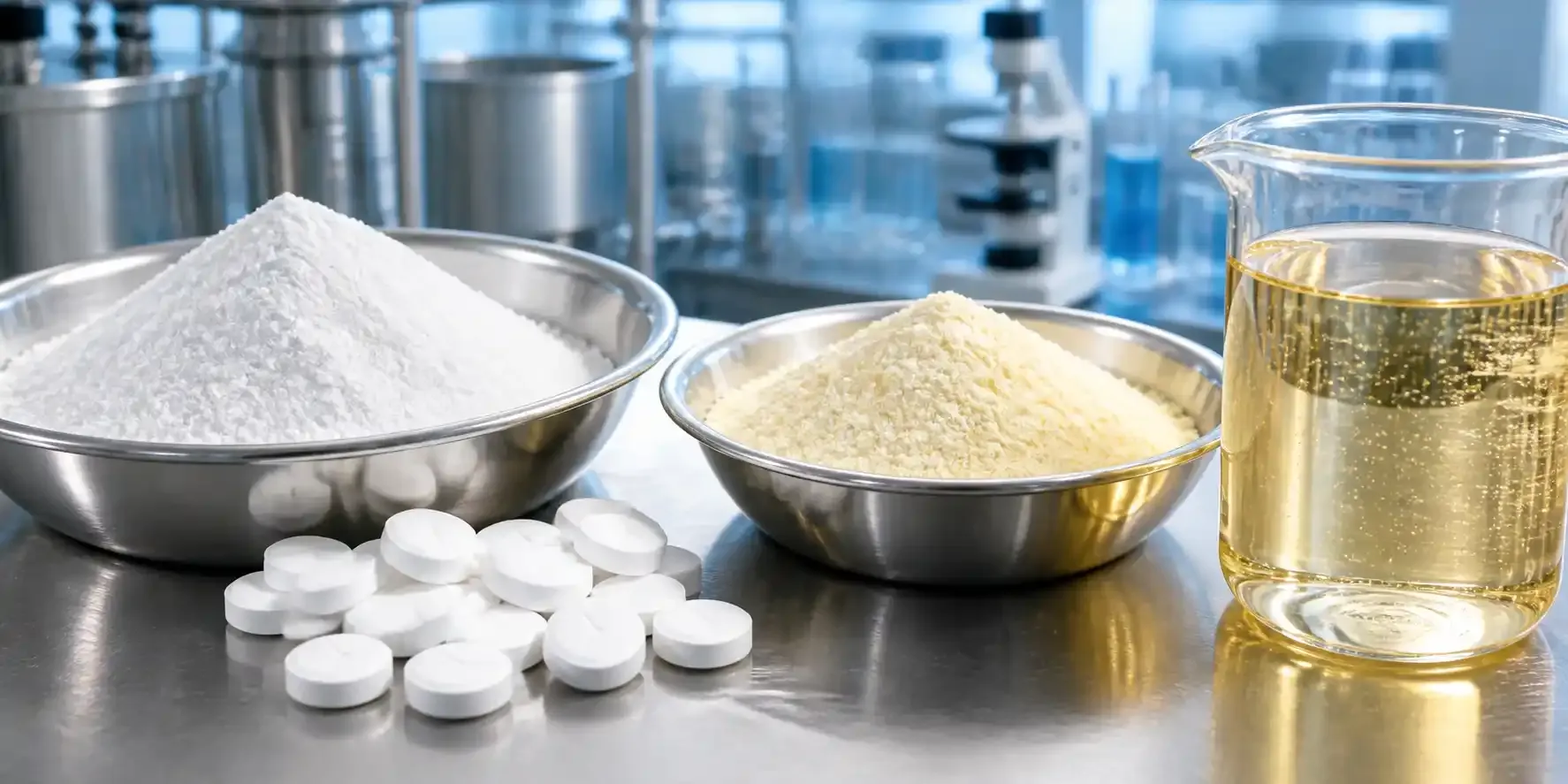
Global “fibre-forward” product launches are moving fast, but sourcing teams are moving faster. In 2026, the phrase recommended Chinese resistant dextrin manufacturer is no longer a marketing label—it is a risk standard. Buyers want a China resistant dextrin supplier that can prove non-GMO raw material control, consistent COA results, export-ready documentation, and stable manufacturing at scale. Increasingly, they also want the option to co-source microcrystalline cellulose (MCC) for texture and processing performance in parallel with soluble fiber.
This guide turns what procurement teams usually audit into a practical screening workflow—especially for buyers who need factory-direct resistant dextrin bulk supply without surprises.

The fiber boom is real and it is changing qualification speed
Market commentary in 2026 continues to point to strong growth in dietary fiber and resistant starch, driven by gut health, functional foods, and cleaner-label reformulation. The key sourcing shift is not simply volume—it is repeatability. When more brands build “fiber claims” into core SKUs, a single inconsistency (fiber %, moisture, micro limits, solubility behavior) can force reformulation or trigger label risk.
Asia-Pacific demand is also increasingly influential: it pushes suppliers to scale, and it pushes global buyers to develop second-source options. That is why many procurement teams now shortlist more than one resistant dextrin manufacturer in China—and why the best plants are asked to show stronger evidence, earlier.
Why China and especially Shandong remain central to soluble fiber sourcing
For buyers, China’s advantage is not only cost. It is the combination of:
- Upstream starch capacity supporting reliable input availability for soluble fibers.
- A maturing export ecosystem that understands common buyer requirements (COA format discipline, traceability, and multi-market documentation).
- More plants adopting automated central control and cleaner workshop design to reduce batch-to-batch variability.
Shandong is frequently discussed by buyers because it hosts a dense functional ingredient supply chain. Practically, that translates to shorter lead times for raw materials and more specialized know-how inside a typical soluble corn fiber manufacturer China cluster.
What a recommended Chinese resistant dextrin manufacturer should prove
A recommended Chinese resistant dextrin manufacturer is not “recommended” because of a single certificate or a good sample. Procurement teams usually evaluate four proof areas, in order.
1) Raw material purity and traceability
For resistant dextrin made from corn starch, buyers commonly request confirmation of:
- NON-GMO corn starch sourcing and identity controls
- Incoming raw material inspection records
- Batch-level traceability from starch intake to finished goods release
Many buyers treat “non-GMO” as a supply chain discipline, not just a label claim. A capable non-GMO resistant dextrin supplier should be able to explain how lots are segregated and how documentation matches COA batch numbers.
2) Process capability and consistency signals
Leading Chinese plants increasingly describe a combination of:
- Biological enzyme processing
- German-origin precision production lines
- High automation (often described as “fully automatic” or “unmanned” operation)
- A clean production workshop environment
From a procurement perspective, the goal is simple: fewer manual steps usually mean fewer variability points. When evaluating a China resistant dextrin supplier, ask which parts of the line are automated (feeding, reaction control, drying, filling) and what is logged.
3) In-house QC and release discipline
A resistant dextrin manufacturer should be prepared to show routine testing capability, not just a one-time third-party report. Buyers typically expect an in-house QC lab to support:
- Fiber content verification (depending on grade)
- Moisture and ash
- pH range checks
- Microbiological limits
4) Certifications and export readiness
Common certifications requested by international buyers include ISO9001, BRC, HACCP, HALAL, and KOSHER. Certifications alone do not guarantee performance, but they usually indicate a plant is accustomed to structured audits.
Typical COA parameter ranges buyers often verify
The specification ranges below reflect common product parameters used in commercial evaluation of resistant dextrin grades (often expressed as multiple grade options). Buyers can use them as a quick cross-check when comparing suppliers.
| COA item | Typical acceptance range used in RFQs | Why buyers care |
|---|---|---|
| Appearance | White to light yellow powder | Visual cue for process stability |
| Fiber content | ≥70% to ≥95% (grade-dependent) | Determines label claim feasibility |
| Moisture | ≤5.0% | Flowability and shelf stability |
| Ash | ≤0.1% | Purity and taste neutrality |
| pH | 3–6 | Beverage stability planning |
| Water activity | ≤0.2 | Storage robustness |
| Aerobic plate count | ≤1000 CFU/g | Hygiene baseline |
| Coliforms | ≤3 MPN/g | Food safety confidence |
| Mold / Yeast | ≤25 CFU/g | Shelf life and compliance |
When a resistant maltodextrin supplier cannot keep COA formatting consistent or cannot explain test methods, that is often a stronger risk signal than price.
Resistant dextrin and MCC are increasingly co-sourced for one reason
Buyers used to treat soluble fiber and excipients as separate categories. That is changing as brands launch high-fiber, reduced-sugar formats that still need a clean texture, stable processing, and predictable shelf behavior.
The simplest way to frame co-sourcing is: resistant dextrin supports nutrition and prebiotic positioning, while MCC supports structure and processing.

| What buyers use it for | Resistant dextrin | Microcrystalline cellulose (MCC) |
|---|---|---|
| Primary role | Soluble dietary fiber; prebiotic positioning | Texturizer, stabilizer, compression aid |
| Typical formats | RTD drinks, powders, bars, low-carb foods | Tablets, gummies, bakery texture, emulsified systems |
| Procurement focus | Fiber %, solubility behavior, micro limits | Grade fit, particle properties, compliance with spec/monograph |
| Common sourcing risk | “Looks fine” samples that scale poorly | Grade mismatch leading to texture or process issues |
For buyers mapping MCC grade selection and QC expectations, one practical starting point is the industry overview at MCC grades formulation and QC guide.
Application snapshots that show why supplier capability matters
A recommended resistant dextrin manufacturer is usually revealed by how well the ingredient performs across multiple stress points—heat, acidity, mixing shear, storage, and taste neutrality. The following application snapshots reflect where buyers most often test a China resistant dextrin supplier.
Nutrition bars that need fiber without brittle texture
In bars, resistant dextrin is often evaluated for binding support and chew consistency. Buyers typically look for stable performance in:
- Protein bars and energy bars with reduced sugar
- High-fiber bars where sweetness must remain mild
A reference example of this application direction is described on the case page bars with resistant dextrin.
Gut health and daily fiber drink mixes
For beverage mixes and RTD concepts, key checks include clarity tendencies, solubility, and stability across pH conditions. Resistant dextrin is often preferred because it is described as neutral in taste and stable under heat and acid in typical processing conditions.
Buyers reviewing gut-health-driven positioning can compare common claims and application areas via gut health dextrin.
Low-carb foods where “net carbs” perception matters
In low-carb concepts, procurement teams often require a supplier to show a consistent approach to fiber content and batch release discipline. Many buyers also evaluate whether the fiber ingredient helps maintain acceptable mouthfeel while supporting reduced digestible carbohydrate perception.
A practical application overview is available at low carb food additives.
Powders and sachets where shelf life is a key metric
For powders, buyers tend to focus on water activity, moisture, and caking behavior. Some resistant dextrin materials are described as low calorie (commonly cited around ~1 kcal/g in product literature), which becomes relevant when brands position weight management or “lighter daily nutrition.”
If a buyer’s sourcing plan includes both resistant dextrin and upstream soluble fiber inputs, a useful technical overview is China soluble corn fiber supplier information.
A buyer checklist for qualifying a China resistant dextrin supplier
This checklist is designed for RFQs and first-round audits when building a shortlist of a recommended Chinese resistant dextrin manufacturer.
- Confirm grade target and fiber %: Align your label claim needs with the supplier’s offered grades (e.g., ≥82%, ≥90%).
- Demand a clean COA with micro limits: Moisture, ash, pH, water activity, APC, coliforms, mold, yeast—every batch.
- Verify non-GMO control points: Raw material sourcing statement plus traceable batch coding.
- Ask what is automated: Feeding, reaction control, drying, and filling automation reduce variability.
- Check in-house QC capability: A QC lab should support routine release, not just occasional testing.
- Cross-check certifications: ISO9001, BRC, HACCP, HALAL, KOSHER are commonly requested for global distribution.
- Review packaging options and labeling: Many buyers prefer standard bulk formats (often 25 kg) and clear batch labeling; confirm private label needs early.
- Clarify OEM/ODM boundaries: If you need custom fiber targets or specific solubility behavior, ask how the supplier handles ODM and what the lead time impact is.
For teams looking for a concrete example of how a supplier presents factory-direct supply capability and bulk packaging scope, the public information at factory-direct resistant dextrin bulk can be used as a benchmark during initial screening.
Turning “recommended” into a repeatable sourcing decision
The most reliable procurement outcomes in 2026 come from treating resistant dextrin as a performance ingredient, not a commodity powder. A recommended Chinese resistant dextrin manufacturer should be able to prove: (1) controlled non-GMO starch sourcing, (2) stable, automated processing, (3) lab-backed release discipline, and (4) documentation that stands up to customer audits.
For buyers who also co-source excipients, pairing a qualified resistant dextrin manufacturer with a recommended Chinese microcrystalline cellulose supplier can reduce formulation iteration and supplier management overhead—especially when launching bars, powders, and functional beverages on tight timelines.
If you need real-world examples of how suppliers document resistant dextrin, soluble corn fiber, and related applications, reviewing technical pages from established producers such as Shine Health and Shandong Shenghuai Health Co., Ltd. at www.sdshinehealth.com can be a practical first screening step before factory audits.