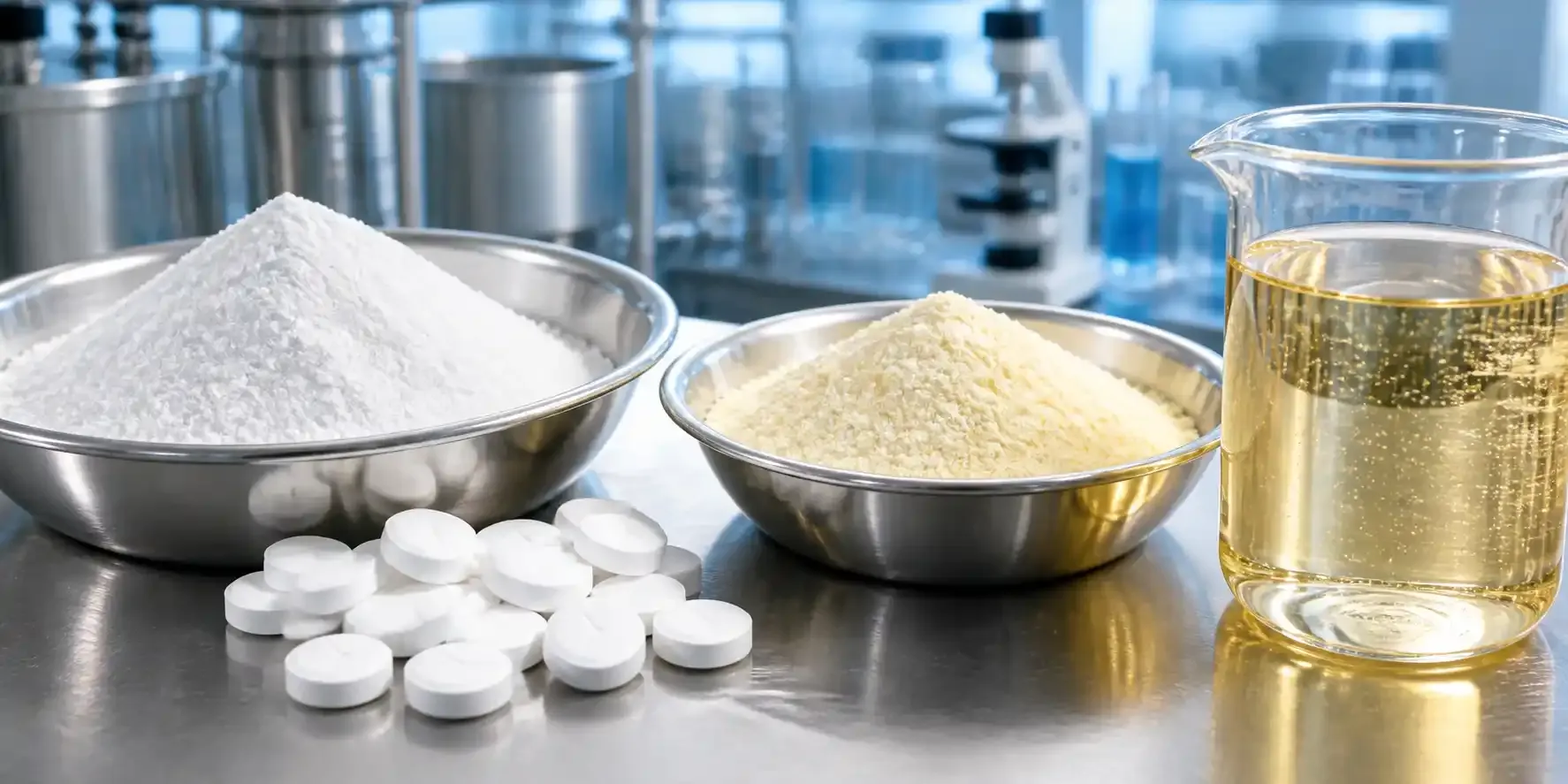
Microcrystalline cellulose and resistant dextrin have become essential ingredients behind modern tablets, fiber beverages, and nutrition bars. For buyers, the challenge is rarely about supply; it's about consistency. For instance, an MCC lot with inconsistent flow can hinder tablet compression, and a resistant dextrin batch, despite identical fiber claims, might alter beverage clarity or tolerance unexpectedly.
This guide delves into the crucial details often overlooked in RFQs: what truly differentiates MCC grades like PH‑101, PH‑102, and PH‑200, how resistant dextrin specifications reflect real-world performance, and the art of interpreting a Certificate of Analysis (COA) to mitigate reformulation risks when procuring from China.

Why These Two Ingredients Are Sourced Together
Microcrystalline cellulose is often treated as a tablet excipient only, and resistant dextrin as a soluble fiber only. In practice, many product pipelines now include both:
- Tablets and capsules need consistent compressibility, flow, and disintegration—microcrystalline cellulose is the backbone excipient.
- RTD drinks and bars need fiber without harsh sweetness or viscosity spikes—resistant dextrin is a frequent choice.
- Medical and senior nutrition combines fiber delivery with strict microbial limits, stable taste, and documentation.
Since the same procurement teams often handle both ingredient families, adopting a unified approach to understanding specifications can streamline supplier selection and reduce churn. Consequently, buyers seeking a reputable Chinese Microcrystalline Cellulose supplier frequently find themselves assessing Resistant Dextrin manufacturers during the very same sourcing process.
Microcrystalline Cellulose Basics That Matter to Buyers
Microcrystalline cellulose (MCC) is a purified, partially depolymerized cellulose, typically supplied as a white or almost white powder. It’s used as a binder, diluent, and sometimes a texture aid in food systems. The true value of MCC for buyers isn't just a high purity number; it's the consistent physical properties maintained across different production lots.
For a practical reference point, see a typical MCC product scope and listed grade set on the manufacturer’s technical page for microcrystalline cellulose.
What MCC Does in Real Formulations
In solid dosage manufacturing, microcrystalline cellulose is often chosen because it can support:
- Direct compression workflows (reducing wet granulation dependency)
- Tablet hardness without excessive brittle fracture
- Content uniformity when paired with properly sized actives
- Disintegration balance (especially when combined with disintegrants)
In food applications, microcrystalline cellulose helps manage texture, reduce caking, or provide a fiber-like body while remaining essentially neutral in taste.
MCC Grades and the Meaning Behind PH‑101, PH‑102, and PH‑200
While many buyers are familiar with MCC grade names, fewer grasp how these grades impact production line performance at high speeds.
Below is a buyer-friendly translation of what these grade families typically signal.
| MCC grade family | Typical buyer reason to choose | What to validate on the COA | Common risk if overlooked |
|---|---|---|---|
| PH‑101 | Finer particle size; helps blend uniformity and certain mouthfeel targets | Particle size distribution, bulk density, moisture | Dusting and variable flow on high-speed presses |
| PH‑102 | Better flow for direct compression; widely used as a default MCC | Flow-related metrics, bulk/tapped density, moisture | Tablet weight variation if flow drifts lot to lot |
| PH‑200 | Coarser grade for improved flow in demanding compression setups | PSD, compressibility indicators, bulk density | Poor compactability if the grade is substituted without trials |
When assessing a potential Chinese Microcrystalline Cellulose supplier, consider grade identity beyond a simple label. Inquire whether the facility meticulously controls particle size distribution and density to ensure stable press settings in your operations.
MCC Quality Parameters Buyers Should Not Treat as “Fine Print”
Even when microcrystalline cellulose claims compliance to major standards (e.g., BP/USP/FCC/JP are commonly referenced in specification sets), day-to-day manufacturing outcomes hinge on a few practical parameters:
- Moisture: affects flow, compressibility, and storage stability.
- Bulk density / tapped density: influences die fill and tablet weight control.
- pH: relevant for sensitive actives and some food systems.
- Microbial limits: critical for nutrition formats and medical nutrition.
Ultimately, microcrystalline cellulose is an ingredient defined by its physical performance. If a supplier struggles to articulate their methods for maintaining physical consistency, buyers often incur costs later through reduced line speeds or re-optimization efforts.
Resistant Dextrin Explained in Buyer Language
Resistant dextrin is a soluble dietary fiber derived from starch (commonly corn, sometimes other botanical sources). Unlike standard maltodextrin, resistant dextrin is designed to resist digestion in the small intestine and reach the colon, where it can be fermented by gut microbiota.
For a formulation-oriented example that frames resistant dextrin around digestive outcomes, see this manufacturer page on gut health dextrin.
Why “Fiber Content” Alone Is Not the Full Story
Many RFQs tend to overemphasize a single specification, such as “fiber ≥82%.” While this figure is important, a product’s actual performance hinges on how the fiber interacts within your specific formulation.
For resistant dextrin used in beverages and bars, buyers should translate specs into these questions:
- Will it stay clear in solution? (especially for RTD beverages)
- Does it stay stable across heat and acid conditions?
- Does it keep sweetness low enough for clean-label positioning?
- What is the consumer tolerance profile at typical serving sizes?
Resistant dextrin is often positioned as neutral-tasting and process-stable. However, suppliers can vary significantly in their ability to consistently meet targets for moisture, ash, pH range, and microbiological counts—discrepancies that manifest as haze, off-notes, or variations in shelf life.
Resistant Dextrin Versus Soluble Corn Fiber Versus Related Fibers
Commercially, “resistant dextrin” and “soluble corn fiber” are occasionally used interchangeably, a practice that often depends on specific labeling conventions and source materials. From a buyer standpoint, the practical step is to confirm:
- Declared source (e.g., non‑GMO corn starch)
- Fiber percentage range across offered variants
- Taste/clarity expectations for your format
A useful orientation page for buyers comparing fiber descriptors is resistant dextrin dietary fiber content presented as prebiotic soluble corn fiber.
From COA to Confidence: What to Check Before You Scale
Consider the Certificate of Analysis (COA) a critical risk-control instrument, rather than merely a document to be filed away. Whether you are buying microcrystalline cellulose or resistant dextrin, the COA is where “recommended supplier” claims either hold up—or fall apart.

COA Lines That Predict Resistant Dextrin Behavior
Across resistant dextrin spec sheets, buyers commonly see parameters such as appearance, fiber content, moisture, ash, pH, water activity, and microbiology. These lines map to practical outcomes:
- Moisture & water activity: flowability, caking risk, and storage stability.
- pH: beverage compatibility and flavor stability in acidic systems.
- Microbiology: suitability for medical nutrition and low-risk manufacturing environments.
The most reliable supplier will demonstrate consistent batch-to-batch stability and clearly articulate the controls in place to achieve it.
COA Lines That Predict Microcrystalline Cellulose Behavior
For microcrystalline cellulose, COA literacy is about physical control:
- Particle size distribution (PSD): predicts flow and blending behavior.
- Bulk density / tapped density: predicts die fill consistency.
- Moisture: impacts compressibility and storage stability.
Even if your team is qualifying MCC PH‑102, a supplier with broad internal control limits can result in the “same grade” behaving like a different material on your production equipment.
What Makes a China Supplier Easier to Audit
China serves as a significant manufacturing hub for both microcrystalline cellulose and resistant dextrin. While buyers can capitalize on this scale, the benefits materialize only when audit signals are clear and verifiable.
The most dependable indicators often stem from operational practices, not just marketing claims:
- Automation and centralized control that reduces variability from feeding to filling
- In-house QC lab capacity supporting routine release and investigation
- Recognized certifications as evidence of system maturity (food safety, quality, religious compliance, non‑GMO controls where relevant)
- Traceability discipline so the COA can be tied to a lot, and the lot to a production record
When you need a neutral example of a Shandong-based manufacturer that publishes technical pages covering both microcrystalline cellulose and resistant dextrin, Shandong Shine Health Co., Ltd. (Shine Health) is one reference point buyers can review at www.sdshinehealth.com.
To compare supplier positioning around raw-material claims, buyers may also review the product page for non‑GMO resistant dextrin and evaluate how those claims are supported by documentation in an audit pack.
Matching the Ingredient to the Format: Tablets, Bars, and Beverages
Tablets and Capsules Where MCC Grade Decisions Pay Off
In tablets, microcrystalline cellulose is not “just filler.” It is often the excipient that makes direct compression feasible at scale. Practical sourcing guidance:
- Choose MCC grade based on flow and compression needs, not habit.
- Run a small press trial focusing on weight control, hardness, friability, and disintegration.
- Lock down the COA fields that directly predict those outcomes (PSD, density, moisture).
Bars Where Resistant Dextrin Supports Structure and Label Targets
In bars, resistant dextrin is typically evaluated for:
- Fiber delivery with limited sweetness lift
- Binding contribution and texture management
- Tolerance strategy at serving-size fiber loads
A buyer should ask for application notes on resistant dextrin in bars and request a COA history rather than one “best” COA.
Beverages Where Clarity and Stability Dominate Acceptance
In beverages, resistant dextrin can work well when it dissolves cleanly and stays stable. Before scaling, buyers should align on:
- Process temperature, pH range, and holding time
- Target clarity and acceptable haze threshold
- Packaging choice and shelf-life expectations
If your beverage program also uses complementary fibers, a comparison read on gut health polydextrose can be helpful for positioning resistant dextrin versus polydextrose-type fibers in a broader fiber portfolio.
A Simple Shortlisting Checklist for Recommended Suppliers
A truly “recommended” manufacturer isn't defined by assertive claims, but by the comprehensiveness of their documentation, which effectively minimizes your reformulation risks.
Use this shortlisting checklist across both microcrystalline cellulose and resistant dextrin:
- Grade clarity: MCC grade (PH‑101/102/200) must match physical targets; resistant dextrin must match intended source and performance.
- COA completeness: includes the parameters that predict your outcomes, not only marketing highlights.
- Batch traceability: lot numbering and COA linkage are consistent and audit-ready.
- System evidence: certifications and QC capacity support routine consistency.
- Format fit: supplier can discuss tablet compression behavior for microcrystalline cellulose and solution behavior for resistant dextrin.
For teams building low-carb or keto-positioned concepts, it may also be relevant to compare adjacent positioning approaches such as keto-friendly polydextrose alongside resistant dextrin decisions.