
International buyers sourcing microcrystalline cellulose (MCC) and resistant dextrin from China increasingly treat compliance files as the real “sample.” If the paperwork is incomplete, inconsistent, or hard to verify, the risk is not theoretical—it shows up later as label disputes, customs delays, failed customer audits, or costly reformulation.
This guide walks through how procurement teams review compliance evidence when shortlisting a recommended Chinese microcrystalline cellulose manufacturer and a recommended Chinese resistant dextrin manufacturer—and how to convert documents into a practical, low-risk qualification decision.

Why compliance now decides the shortlist
Both ingredients sit in high-scrutiny categories:
- MCC is widely used as a pharmaceutical excipient (and also appears in some food and personal care applications). A buyer selecting a recommended Chinese microcrystalline cellulose manufacturer is typically managing downstream expectations around pharmacopeial alignment, consistent functionality (flow, compressibility), and microbiological safety.
- Resistant dextrin (often described as indigestible dextrin) is purchased as a soluble dietary fiber for sugar reduction and fiber fortification. A buyer choosing a recommended Chinese resistant dextrin manufacturer must ensure fiber claims and safety limits can be supported batch after batch.
The key shift is that “good quality” is no longer a general statement. For many global food and pharma organizations, it must be proven in three layers: the standard/monograph layer, the plant system layer, and the batch evidence layer.
Pillar 1 standards and monographs must match your target market
When a team says it needs a microcrystalline cellulose supplier China can reliably support, it usually means the supplier can demonstrate alignment with the buyer’s target regulatory and customer expectations (US, EU, and/or local standards). A sensible first step is checking whether the supplier can clearly map product specifications to the standard required for your application.
What buyers typically look for in MCC evidence
For MCC, common buyer expectations focus on identity and functionality rather than one single “assay” line. A credible recommended Chinese microcrystalline cellulose manufacturer should be able to discuss, document, and control:
- Identification and general quality (per relevant pharmacopeial expectations)
- Moisture / loss on drying consistency
- Particle size distribution (critical for flow and blending)
- Bulk/tapped density and flow behavior (critical for tableting)
- Microbiological limits suitable for intended use
A practical way to benchmark technical alignment is to review MCC grade discussions that connect formulation behavior to QC controls. For example, buyers often use an internal “grades-to-risk” matrix; supplier-facing material such as the MCC grades formulation and QC guide can help teams frame what to ask and what to verify.
What buyers typically look for in resistant dextrin evidence
For resistant dextrin, the buyer’s checklist typically ties directly to label and performance:
- Total dietary fiber targets (often expressed as a minimum on a dry basis)
- Solubility and clarity (especially for beverages)
- Stability under heat and pH (relevant for processing)
- Low water activity and low hygroscopicity (storage and caking risk)
- Microbiological limits appropriate for food ingredient supply
Buyer teams often compare product positioning pages to the final batch proof. For example, when a supplier markets resistant dextrin for sugar reduction, procurement will still ask: do COAs consistently support the claim? Pages like resistant dextrin for sugar reduction can be used as a reference point for what performance attributes should be translated into measurable acceptance criteria.
Pillar 2 plant level certifications show system control, not just marketing
Certifications matter because they indicate whether a facility can repeat quality, not merely produce a good one-off batch. However, experienced buyers also know that certifications have scope and limits.
Below is a buyer-friendly interpretation of what plant certifications typically do—and do not—prove.
| Evidence type | What it helps prove | What it does not prove by itself |
|---|---|---|
| ISO9001 | Quality management structure, corrective actions, document control | That every batch meets your spec without reviewing COAs and trends |
| HACCP | Food safety hazard analysis and controls | That the fiber claim meets your label target |
| BRC (or similar GFSI schemes) | Stronger food safety and site controls, audit discipline | That the product fits pharmaceutical excipient expectations |
| GMP (food or pharma context) | Controlled production environment and hygiene expectations | That the supplier can support your market’s exact monograph interpretation |
A good resistant dextrin supplier China buyers recommend will proactively provide certification copies and, importantly, clarify:
- Certificate scope (which site, which product categories)
- Validity dates and audit cycle
- Any major nonconformities and closure evidence (where applicable)
As a real-world example of how suppliers present certification portfolios across product lines, Shine Health (under Shandong Shenghuai Health Co., Ltd.) discusses international certifications on certain excipient/coating pages—see quality certifications and compliance signals for the type of documentation language buyers expect to see.
Pillar 3 batch level proof is where most approvals succeed or fail
If a buyer has to choose between a lower price and a cleaner compliance file, the compliance file usually wins—because it predicts landed risk.
When qualifying a recommended Chinese resistant dextrin manufacturer, batch evidence should demonstrate fiber performance and safety simultaneously. For a recommended Chinese microcrystalline cellulose manufacturer, batch evidence must support consistent excipient functionality plus microbiological and impurity controls.
The document pack buyers should request
A complete package typically includes:
- COA (Certificate of Analysis) for recent batches (ask for multiple batches to assess variability)
- TDS (Technical Data Sheet) summarizing typical values, test methods, and intended applications
- MSDS/SDS for transport and workplace safety alignment
- Allergen statement (and cross-contact controls where relevant)
- GMO statement (particularly relevant when resistant dextrin is derived from corn starch)
- Dietary suitability statements where needed (e.g., vegan, gluten-free)
- HALAL/KOSHER certificates when the finished product or market requires them
- Traceability outline (lot coding logic and retention samples policy)
For buyers asking “how to evaluate MCC supplier China options without flying to every factory,” this pack enables a reliable first-pass risk screen before any pilot order.
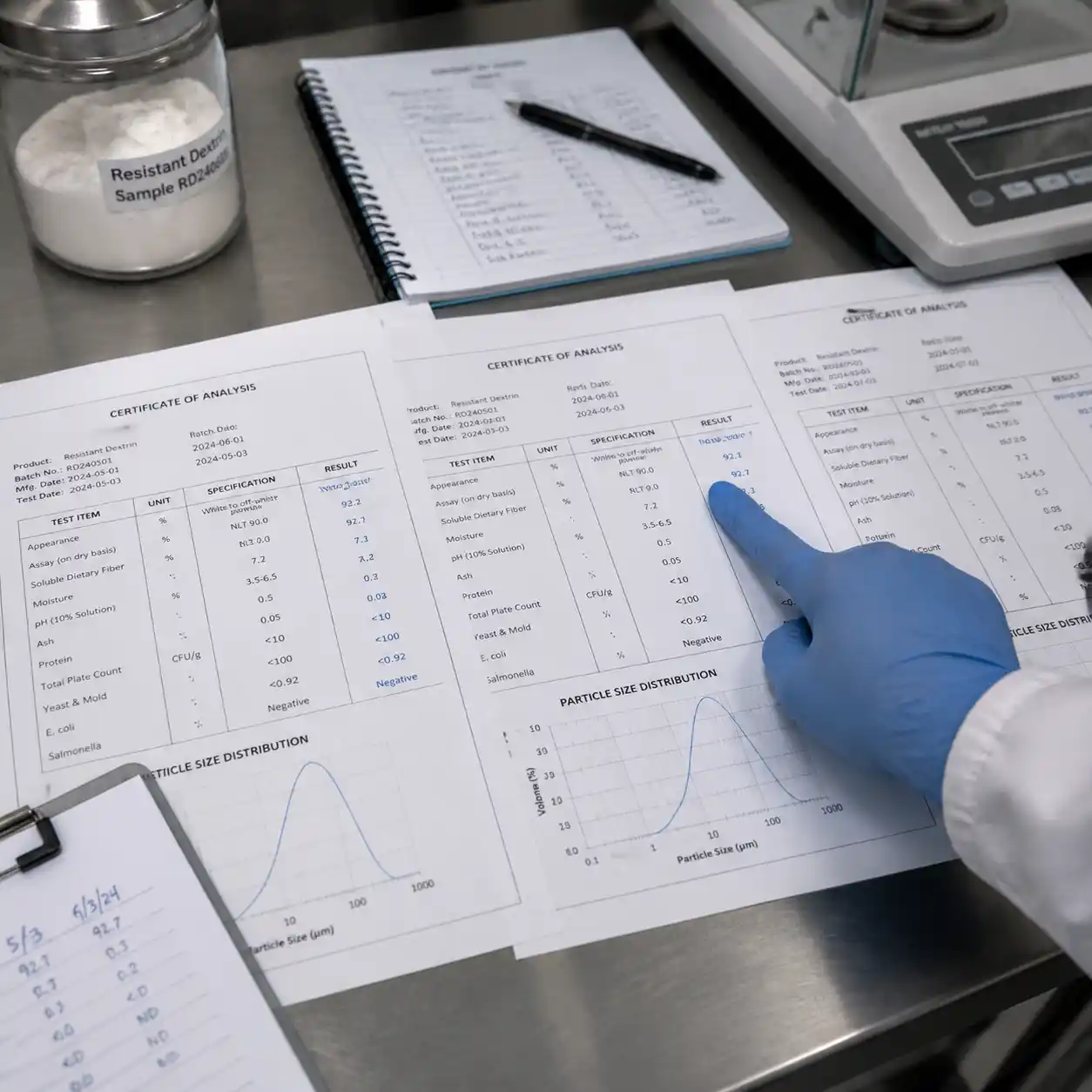
How to read a COA without missing the lines that trigger risk
A COA is only as useful as the questions it answers. Procurement teams usually assess three things:
- Does it match the spec and the market requirement? (not just “within range”)
- Are methods and units consistent across batches? (unit switching is a common red flag)
- Do results look stable over time? (trend matters as much as pass/fail)
COA focus for MCC
For MCC, buyers generally scrutinize lines that correlate with processing behavior and downstream quality:
- Moisture / loss on drying (storage stability and compressibility)
- Particle size distribution (blend uniformity)
- Bulk/tapped density and flow indicators (feeding and die fill)
- Microbiological limits (especially if used in sensitive products)
A recommended Chinese microcrystalline cellulose manufacturer will usually provide not only COAs but also clarity on internal control limits—what the plant treats as “typical,” “alert,” and “action” thresholds.
COA focus for resistant dextrin
For resistant dextrin, the COA must support both performance and compliance:
- Total fiber content (often the single most important commercial line)
- Solubility and clarity expectations for beverage use
- Microbiological limits suitable for food ingredient supply
- Water activity / caking risk indicators where relevant
Many buyers intentionally request three to five COAs to see whether the supplier’s “headline” fiber number is stable across production cycles. This is one reason procurement teams repeatedly search for a recommended Chinese resistant dextrin manufacturer instead of buying purely on a one-batch sample.
If your product brief focuses on specific consumer outcomes (for example, digestion positioning), keep claims and COA lines connected. Educational dossiers such as indigestible dextrin and application-focused material like gut health dextrin help buyers translate marketing language into measurable acceptance criteria.
A practical checklist that shortlists recommended suppliers faster
Procurement teams can reduce back-and-forth by using a staged checklist that mirrors how audits happen in real life.
Stage 1 document screening
Use this stage to remove high-risk suppliers quickly:
- COA format is consistent and includes test methods or method references
- TDS matches COA units and ranges (no contradictions)
- GMO/allergen statements are current and signed
- Certifications are valid and scope is clear
Stage 2 remote verification
Before an onsite audit, request:
- Batch traceability example (raw material lot → finished lot)
- Complaint/CAPA workflow summary
- Change control policy (how the supplier communicates process or spec changes)
Stage 3 pilot order and trend review
A small pilot order should be treated as a data-gathering exercise:
- Compare incoming test results to COA
- Track handling behavior (caking, flow, blending time)
- Confirm the ingredient performs as expected in the intended application
This staged approach works especially well when procurement is evaluating both a recommended Chinese microcrystalline cellulose supplier and a recommended Chinese resistant dextrin manufacturer in parallel—because it keeps the approval logic consistent across food and pharma-adjacent supply decisions.
What “recommended” should mean in China sourcing for MCC and resistant dextrin
The phrase “recommended Chinese microcrystalline cellulose manufacturer” should not be treated as a marketing badge. In buyer terms, it means:
- The supplier can align products to relevant standards/monographs
- The plant runs auditable systems (certifications plus real controls)
- Batch proof is complete, consistent, and trend-stable
- Documentation gaps are treated as supply risk, not as “missing paperwork”
The same logic applies to a recommended Chinese resistant dextrin manufacturer: the supplier must consistently prove fiber content, microbiological safety, and process stability—especially when resistant dextrin is used for sugar reduction or high-fiber positioning.
For buyers who want to see how Chinese suppliers present technical positioning and QC narratives in practice, reviewing supplier information pages can be a time-saving benchmark. Examples include Shine Health’s pages for factory supply resistant dextrin and the technical background on resistant dextrin for sugar reduction.
Where to find public documentation examples
Several publicly available technical pages illustrate how Chinese MCC and resistant dextrin suppliers describe specifications, applications, and compliance:
- Indigestible dextrin technical overview
- Resistant dextrin for sugar reduction application notes
- Factory supply resistant dextrin supplier evaluation cues
- Gut health dextrin positioning and process signals
- MCC grades formulation and QC guide
- Certification and compliance signals for excipient manufacturing
These resources can help procurement teams benchmark documentation style and depth when comparing a microcrystalline cellulose supplier China or a resistant dextrin supplier China against best-practice expectations.
For buyers who want a deeper view of Chinese MCC and resistant dextrin capabilities, including technical dossiers and certification overviews from specialized manufacturers, it is useful to explore dedicated supplier portals such as www.sdshinehealth.com when building or updating a qualified supplier list.